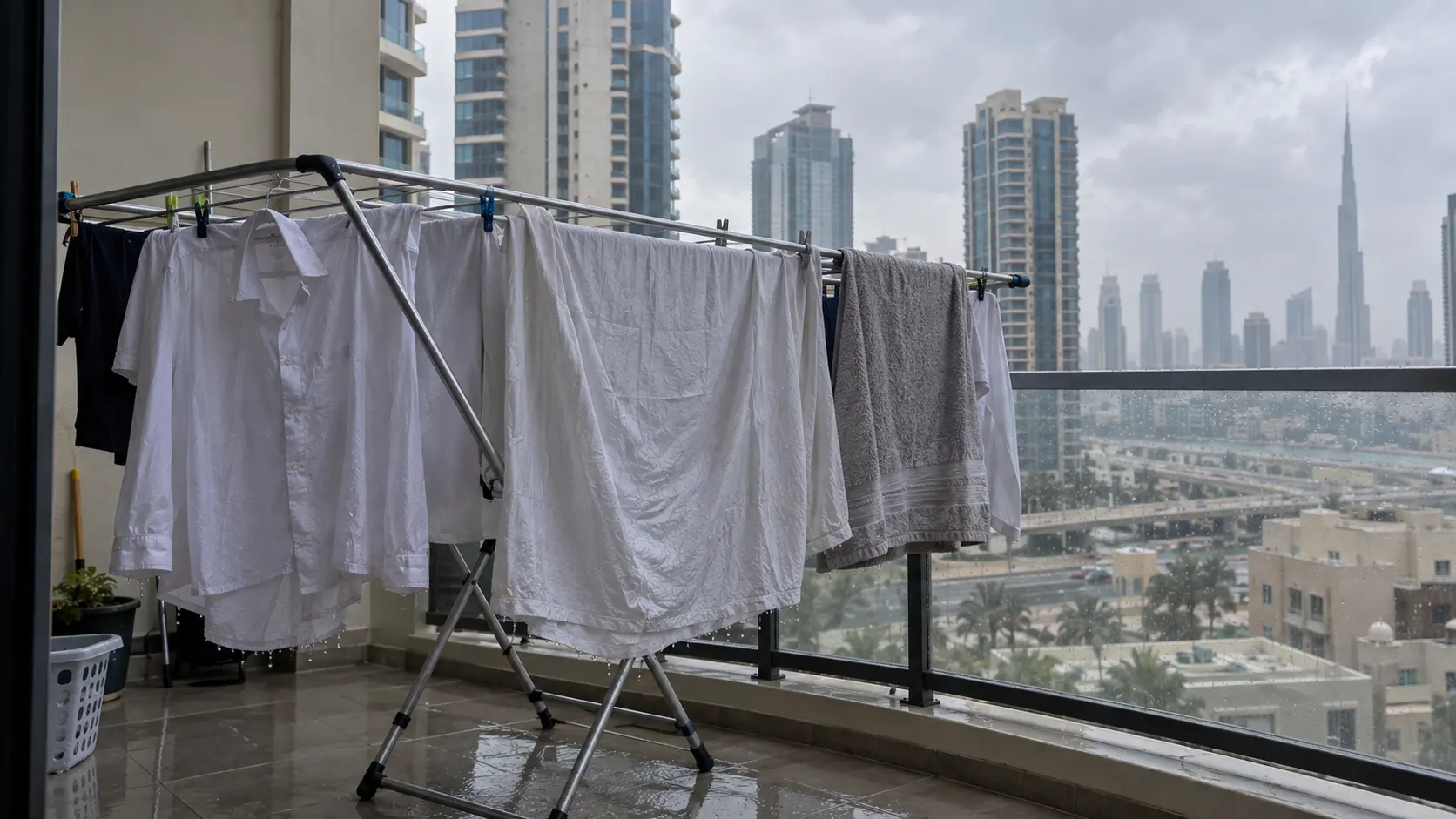
Why Your Clothes Dry Slower in January Than in July in Dubai
Your clothes dry slower in January than in July because Dubai's humidity peaks in winter, not summer. Mean relative humidity is 65.8% in January and 64.7% in February, against 52.8% in May and 54.0% in July. Wet fabric gives up water only as fast as the surrounding air will take it, so a load hung out on a mild January evening can still be damp the next day, while the same load in July is dry within hours. Heat is not what dries your washing. Dry air is.
This catches almost everyone out, because it contradicts how a Dubai summer feels. Below is the measured year, and what it means for how you wash between November and March.
What does Dubai's humidity actually do across the year?
Relative humidity runs highest from December to February, peaking at 65.8% in January. It falls through spring to a low of 52.8% in May, stays near that level through the hottest months, then climbs again from September. The swing between wettest and driest month is 13 percentage points.
| Month | Relative humidity | Mean temperature | Outdoor drying |
|---|---|---|---|
| January | 65.8% | 19.6°C | Slowest |
| February | 64.7% | 20.6°C | Very slow |
| March | 61.5% | 23.2°C | Slow |
| April | 54.2% | 26.9°C | Good |
| May | 52.8% | 30.8°C | Fastest |
| June | 55.1% | 33.7°C | Good |
| July | 54.0% | 35.4°C | Good |
| August | 54.0% | 35.3°C | Good |
| September | 59.6% | 33.0°C | Moderate |
| October | 61.5% | 29.9°C | Slow |
| November | 59.7% | 25.9°C | Slow |
| December | 63.4% | 21.9°C | Very slow |
Note what the last two columns do together. January is the most humid month and the coolest. Both push in the same direction, and that is why winter drying fails.
Why does damp air stop clothes drying, even on a pleasant day?
Drying is not heat forcing water out of fabric. It is water moving from wet cloth into the surrounding air, and that only continues while the air has room to accept more. Relative humidity measures how full the air already is.
At 65.8% it is roughly two-thirds full before your washing arrives. In May, at 52.8%, it is closer to half empty and pulls moisture out noticeably faster.
Then the sun sets. Cooler air holds less moisture, humidity climbs towards saturation, and the transfer slows further or stops. A balcony line left out overnight in January can be wetter at dawn than it was at dusk.
What actually goes wrong with a winter wash load?
Three things in sequence. The load fails to dry within a day, it re-absorbs moisture overnight, and the extended damp period breeds the bacteria behind that musty smell. At that point it needs re-washing, so the load costs twice the water, twice the detergent and two days.
- Heavy items stall first. Towels, jeans, bedding and kanduras hold far more water to begin with.
- Indoor racks in sealed rooms make it worse. A closed room rises to match the humidity of the washing, then stops.
- The smell does not air out. It is bacterial growth in the fibres, not trapped odour on the surface.
- Cool to the touch means still wet. Evaporation draws heat, so damp fabric reads cooler than the room.
The winter version of a laundry problem is rarely a stain. It is a load that never properly dried, and got folded away anyway.
Does air conditioning help or hurt?
It helps only when air is moving. Air conditioning does pull moisture out of a room, but a closed bedroom with a full drying rack reaches equilibrium quickly and then stalls, while pushing that moisture into the space you sleep in.
A fan directed across the fabric does more for drying time than lowering the room temperature does. Airflow, not cold, is what moves the boundary layer of saturated air sitting against the cloth.
How should you change your routine from November to March?
Shift the whole cycle earlier and stop treating the balcony as the default. The aim is to get fabric from wet to dry inside about eight hours, which is roughly the window before odour-causing bacteria establish.
- Wash in the morning, never the evening. An evening load hung overnight is the most common cause of a musty re-wash.
- Use the highest safe spin speed. Every extra minute of spin removes water the air does not then have to.
- Space items out. A crowded line or rack traps a pocket of saturated air that never clears.
- Bring washing in before sunset. After dark the humidity works against you.
- Dry indoors with a fan, not a closed room. Circulation matters more than temperature.
- Do not put away anything that feels cool. Cool almost always means still damp.
What about kanduras, abayas and heavy fabrics?
They fail first in winter and cost the most to get wrong. A kandura holds a lot of water, must dry flat and white, and picks up a grey cast if it stays damp. An abaya's weight and lining make it slower still.
These are the items worth handing over rather than gambling on a balcony line between December and February.
Is this the same across the UAE?
Broadly yes, with coastal areas running slightly damper than inland ones. Across the Gulf as a whole, though, the UAE's defining constraint is different from its neighbours: drying time, rather than airborne dust or coastal salt.
| Market | Peak months | Mean max | Humidity then | Asks most of a wash |
|---|---|---|---|---|
| UAE | Jun–Jul–Aug | 40.6°C | 54.4% | Drying time |
| Qatar | Jun–Jul–Aug | 41.3°C | 47% | Airborne dust |
| Kuwait | Jun–Jul–Aug | 43.9°C | 25% | Airborne dust |
| Bahrain | Jul–Aug–Sep | 38.5°C | 57% | Coastal salt |
| Saudi Arabia | Jun–Jul–Aug | 42.9°C | 12.2% | Perspiration salts |
Kuwait's air at 25% humidity dries a load quickly but carries dust. The UAE's sits at 54.4% through its hottest months, which is why drying time is the thing that defines laundry here.
When is it worth handing winter laundry over?
When drying, not washing, is the part you cannot control. A machine wash at home is straightforward in any season. Getting a full load from wet to properly dry inside eight hours during a 65.8% humidity January is what defeats most households.
Our wash and fold service returns laundry dried and folded within 24 hours, and clean and press covers anything needing finishing. Free pickup and delivery across every area of the UAE, including Dubai.
What does a failed winter load actually cost you?
More than the re-wash. A load that fails to dry costs a second lot of water, detergent and electricity, two days of the garment being unavailable, and a measurable slice of its usable life. Repeated wash cycles are the main driver of fabric wear, well ahead of actually wearing the item.
- Double the water and detergent for one clean set of clothes.
- Two days instead of one before the item is wearable again.
- Extra fibre loss. Every wash sheds fibre, and the second one was avoidable.
- Colour loss compounds with each additional cycle, particularly on darks.
- The smell may persist if the first attempt sat damp long enough.
Across a winter, a household re-washing two loads a week runs roughly thirty avoidable cycles. That is the real cost of treating the balcony as free.
How do you tell when something is actually dry?
By temperature, not by feel. Fabric still holding moisture reads cooler than the air around it, because evaporation is drawing heat out of it. If a garment feels cool to the back of your hand, it is not finished however dry the surface seems.
- Check the thick parts: seams, waistbands, collars, cuffs and pockets dry last.
- Compare to the air temperature, not to your skin.
- Press folded fabric together — trapped dampness shows immediately.
- When in doubt, another hour with airflow beats putting it away.
Putting away a garment that is ninety per cent dry is how a whole drawer ends up smelling musty. The damp item raises the humidity of the closed space around it.
Does detergent choice change in winter?
Slightly. Most detergents are formulated to work at 30°C and above, and mains water runs noticeably colder in January than in July. A cold-water formulation, or a marginally warmer cycle, dissolves and rinses more completely.
Undissolved detergent left in fabric is its own problem: it attracts moisture and contributes to the stiff, slightly tacky feel that usually gets blamed on hard water.
Does this apply outside Dubai?
The seasonal shape holds right across the UAE, with coastal areas running a little damper than inland ones. Abu Dhabi and Sharjah follow the same winter peak and spring trough; the further inland you go, the wider the daily swing between afternoon and overnight humidity.
What does not change is the ordering. Wherever you are in the country, January and December are harder for drying than July, and the reason is always the moisture already in the air rather than the temperature.
The short version
- Dubai's humidity peaks in January at 65.8%, not in summer.
- The driest month is May at 52.8%, with July and August close behind at 54.0%.
- January is both the most humid month and the coolest, so both factors slow drying together.
- Fabric damp for more than about eight hours develops a musty smell that needs a re-wash.
- Wash in the morning, spin harder, space the line out, bring it in before sunset.
- Indoors, a fan beats a closed air-conditioned room.
Humidity and temperature figures are mean monthly values for Dubai from the Open-Meteo ERA5 reanalysis archive, 2015–2024, licensed CC BY 4.0. Last reviewed September 2026.