The Dubai Laundry Calendar: The Best and Worst Months to Dry Outdoors
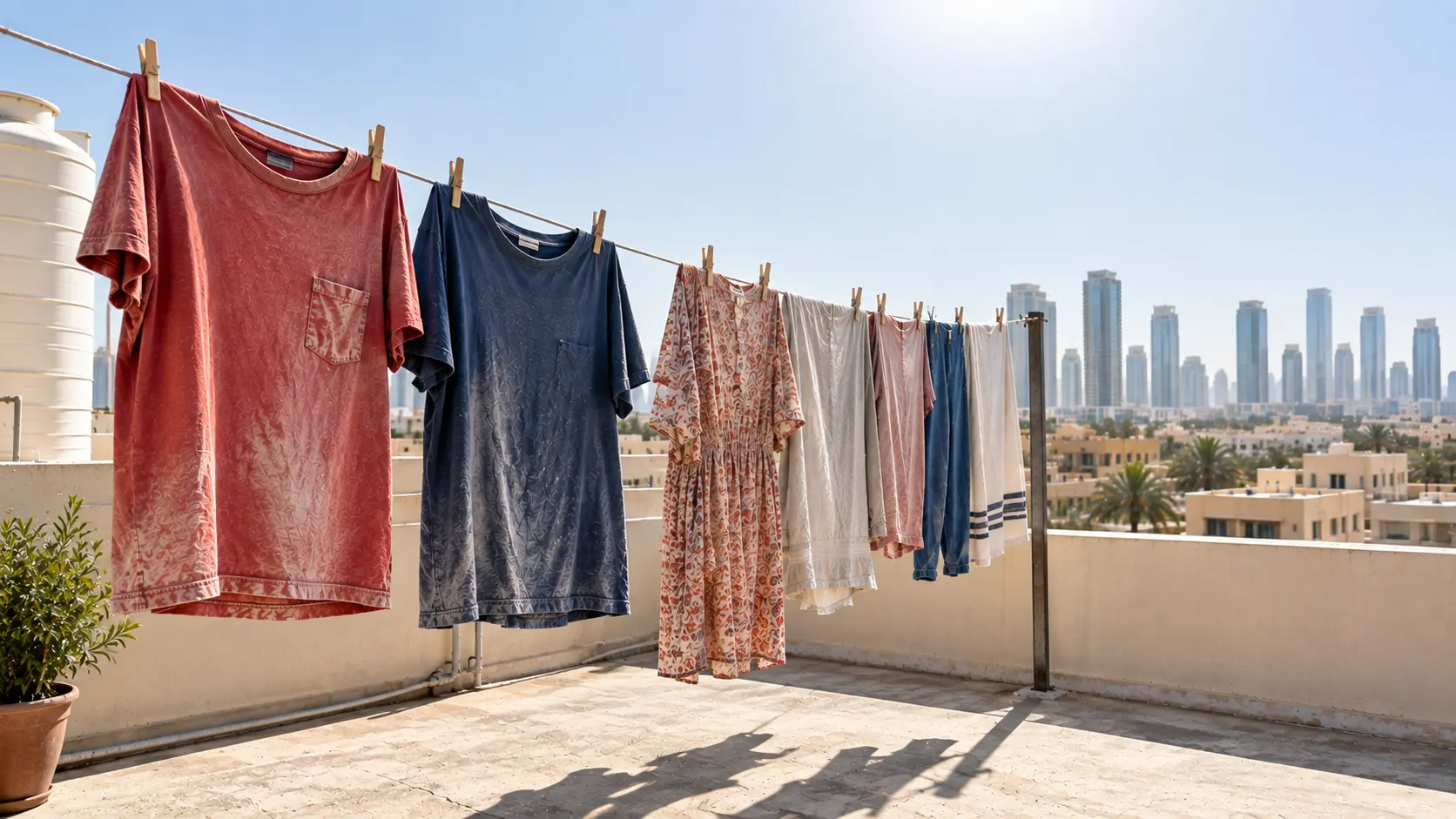
The best months to dry clothes outdoors in Dubai are April through July, and the worst are December through February. What changes is not just how fast things dry but why they fail. In winter, humidity of up to 65.8% means a load may not dry within a day at all. In high summer, drying is fast but direct sun fades colour and airborne dust settles into fabric while it is still wet. Two opposite problems, one calendar.
Here is the month-by-month verdict, and what to do in each part of the year.
Which months are actually good for outdoor drying?
April and May are the best of the year. Humidity has dropped to 54.2% and 52.8%, the sun is not yet at its harshest, and dust activity is lower than in high summer. June and July dry quickly too, but by then UV is the limiting factor rather than moisture.
| Month | Humidity | Mean temp | Main risk | Verdict |
|---|---|---|---|---|
| January | 65.8% | 19.6°C | May not dry | Avoid |
| February | 64.7% | 20.6°C | May not dry | Avoid |
| March | 61.5% | 23.2°C | Slow | Workable |
| April | 54.2% | 26.9°C | Low | Best |
| May | 52.8% | 30.8°C | UV building | Best |
| June | 55.1% | 33.7°C | UV, dust | Shade only |
| July | 54.0% | 35.4°C | UV, dust | Shade only |
| August | 54.0% | 35.3°C | UV, dust | Shade only |
| September | 59.6% | 33.0°C | UV easing | Workable |
| October | 61.5% | 29.9°C | Slowing | Workable |
| November | 59.7% | 25.9°C | Slowing | Workable |
| December | 63.4% | 21.9°C | May not dry | Avoid |
Two clearly good months, six workable, three to shade, three to avoid. That is a narrower window than most people assume when they decide outdoor drying is simply free.
Why is peak summer a shade-only season rather than a good one?
Because the limiting factor changes. Humidity at 54% dries a load quickly, so speed is not the issue. What goes wrong is that direct overhead sun strips colour from dyed fabric, and airborne dust lands on cloth while it is still wet and dries into the weave.
Dust on dry clothing brushes off. Dust absorbed into wet fibres does not, and the load needs re-washing, which cancels out any time the sun saved.
The fade is the part that compounds quietly. We go through the mechanism in why clothes fade so fast in Dubai sun.
Why does winter fail in the opposite direction?
Because nothing dries. Humidity peaks at 65.8% in January while temperatures are at their lowest, and wet fabric releases water only as fast as the surrounding air will accept it. At that level the air is already two-thirds full.
Overnight it gets worse, as cooling air pushes humidity towards saturation and can reverse the day's progress. Fabric that stays damp long enough develops a musty smell that needs a re-wash.
When is peak laundry season in the UAE?
June, July and August, when the mean daily maximum reaches 40.6°C. Volume rises because perspiration shortens how long anything can be worn between washes, not because drying conditions are poor.
That combination is specific to the UAE. Across the Gulf, each market has a different dominant constraint, and the UAE's is drying time rather than dust or salt.
| Market | Peak months | Mean max | Humidity then | Asks most of a wash |
|---|---|---|---|---|
| UAE | Jun–Jul–Aug | 40.6°C | 54.4% | Drying time |
| Qatar | Jun–Jul–Aug | 41.3°C | 47% | Airborne dust |
| Kuwait | Jun–Jul–Aug | 43.9°C | 25% | Airborne dust |
| Bahrain | Jul–Aug–Sep | 38.5°C | 57% | Coastal salt |
| Saudi Arabia | Jun–Jul–Aug | 42.9°C | 12.2% | Perspiration salts |
| Oman | May–Jun–Jul | 38.3°C | 43.3% | Drying time |
Kuwait is hotter and far drier, so its loads dry fast and its problem is dust. Bahrain is cooler and damper with salt in the air. The UAE sits in between, which is why advice copied from either neighbour fits badly.
What should you actually do, season by season?
- April and May: hang anything, anywhere. The best drying of the year.
- June to August: shade with airflow only. Turn darks inside out, bring loads in promptly.
- September to November: workable. Hang by mid-morning, indoors before sunset.
- December to February: assume outdoor drying will not finish. Plan indoors with a fan, or hand it over.
- March: transitional. Fine on a dry, breezy day, slow otherwise.
Outdoor drying in Dubai is free for four months of the year. For the other eight it costs you either colour or a re-wash.
What never belongs on an outdoor line here?
- Silk and fine synthetics — UV weakens the fibre, not just the dye.
- Dark and printed cotton in summer — the fade is fastest and most visible.
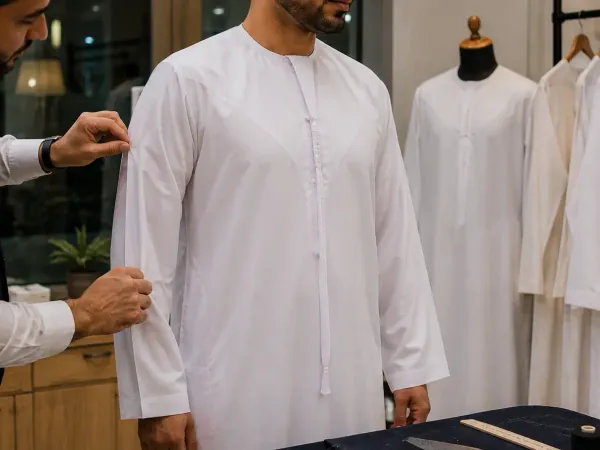
- Kanduras and abayas — weight, drape and colour all suffer.
- Towels, bedding and jeans in winter — too much water to finish in a day.
- Tailored or lined garments — hanging wet distorts the shape.
When is it worth handing over instead?
For eight months of the year, on anything you care about. The good window is genuinely good, but outside April to July the outdoor line is trading garment life for convenience.
Our wash and fold service returns laundry dried and folded within 24 hours, with no UV and no dust, and clean and press covers anything needing finishing. Free pickup and delivery across the UAE, including Dubai.
Does the calendar change what you should wash, not just when?
Yes, and this is the part most seasonal advice misses. The good months are the right time to deal with bulky items that will not dry easily later, and the bad months are the time to shorten the queue rather than lengthen it.
- April and May: tackle curtains, bedding, heavy cottons and anything stored seasonally.
- June to August: everyday wear only, dried in shade. Leave bulky items alone.
- September to November: good window for a second pass at heavy items.
- December to February: keep loads small and frequent rather than large and occasional.
A large winter load is the worst of both worlds: it takes longest to dry in the month least able to dry it, and it occupies the whole line while it fails.
Does indoor drying work year-round?
In summer it is often the better choice outright, because it removes UV and dust entirely while humidity is low enough for a rack to work. In winter it helps only with genuine airflow, since a closed room rises to match the humidity of the washing and then stalls.
An indoor rack in a ventilated room with a fan comfortably beats a January balcony. The same rack in a sealed, air-conditioned bedroom does not, and it pushes that moisture into the room you sleep in.
Balcony, rooftop or indoors?
- Shaded balcony: the best summer option — airflow without direct UV.
- Open balcony: fine in April and May, punishing for colours from June.
- Rooftop: best airflow, worst UV. Good in winter, poor in summer.
- Indoors with a fan: the only reliable option from December to February.
- Enclosed balcony with windows shut: effectively a sealed room, and stalls the same way.
How do you tell when something is actually dry?
By temperature rather than by feel. Fabric still holding water reads cooler than the surrounding air, because evaporation draws heat out of it. A garment that feels cool to the back of your hand is not finished, however dry the surface seems.
This matters most in the three months to avoid, when a load can feel dry on the outside while seams, waistbands and hems still hold water. Those are the parts that later smell musty in a closed drawer.
The short version
- Best: April and May — low humidity, manageable sun.
- Shade only: June, July, August — UV fade and dust, not humidity.
- Avoid: December, January, February — humidity of 63–66% stops drying.
- Peak laundry volume is June to August at a 40.6°C mean maximum.
- Dust on wet fabric bakes in and needs a re-wash; on dry fabric it brushes off.
- The UAE's defining constraint is drying time, unlike Kuwait's dust or Bahrain's salt.
Humidity and temperature figures are mean monthly values for Dubai from the Open-Meteo ERA5 reanalysis archive, 2015–2024, licensed CC BY 4.0. Last reviewed September 2026.