Why Clothes Fade So Fast in Dubai Sun, and How to Stop It
Clothes fade fast in Dubai because direct overhead sun breaks the dye molecules in fabric apart, and the UAE gets a great deal of it. The damage shows on dark and bright cottons within hours of midday exposure, it is permanent, and it is uneven because the side facing the sun takes nearly all of it. Nobody notices it happening. They notice a favourite shirt looking tired about four months sooner than it should.
The fix is not complicated, but it runs against the instinct that strong sun means fast drying and is therefore good.
What is actually happening to the fabric?
Ultraviolet light carries enough energy to break the chemical bonds that give a dye its colour. Once broken, those bonds do not reform. The dye is not washed out or covered up, it is destroyed, which is why fading cannot be reversed.
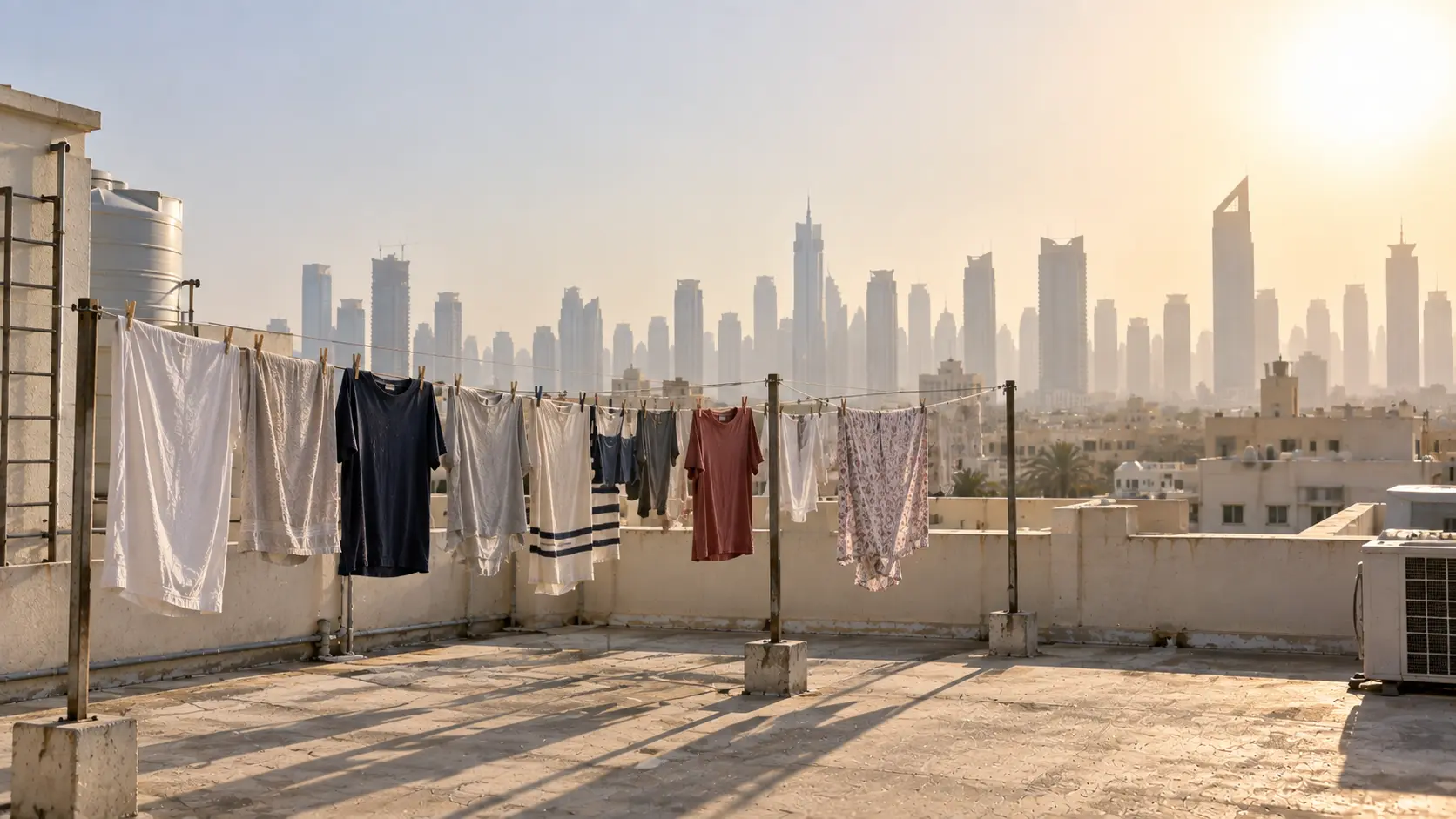
Two things make it worse here than in a temperate climate: the sun sits far higher overhead, so the light is more intense, and drying happens outdoors in that light rather than indoors.
Why is the fading uneven?
Because a hanging garment only presents one face to the sun. The outward side receives direct radiation for the whole drying period while the shaded side receives a fraction of it.
That is the tell. Even fading across a whole garment usually means age or washing. Fading on one side, across the shoulders, or along the fold line over the washing line means sun.
Which fabrics and colours suffer most?
Dark, saturated colours on natural fibres lose the most, because they carry the most dye and the loss is most visible against the original shade. Whites and pale neutrals hold up well, since there is little dye to destroy.
| Fabric or colour | UV risk | What to do |
|---|---|---|
| Black, navy, deep red cotton | Highest | Shade only, or dry indoors |
| Bright dyed cotton and linen | High | Shade, or turn inside out |
| Denim | High | Inside out, shade |
| Silk and fine synthetics | High — fibre damage too | Never in direct sun |
| Printed or patterned fabric | High on the print | Inside out, shade |
| Pale neutrals and pastels | Moderate | Direct sun acceptable |
| White cotton, bed linen, towels | Low — mild bleaching helps | Direct sun is a benefit |
Silk is the one people underestimate. UV does not only take the colour, it weakens the fibre itself, so a silk garment dried in direct sun becomes brittle as well as dull.
Sun drying does not ruin a garment in one afternoon. It ages it slightly faster every single week, which is exactly why the cause never gets blamed.
Is drying in shade actually slower?
Much less than people assume, because sunlight is not what does most of the drying. Moving air is. Shade with good airflow dries a load nearly as fast as direct sun once the humidity is low, and costs no colour at all.
That trade only holds when the air is dry. In a Dubai January at 65.8% humidity, neither shade nor sun will finish a load reliably, which we cover in why clothes dry slower in January than July.
How do you dry without the damage?
Get the load out of direct midday light and keep air moving across it. Almost every fading problem we see traces back to timing and position rather than to the washing itself.
- Dry coloured items in shade with airflow. A shaded balcony beats an exposed one comfortably.
- Hang early morning or late afternoon if shade is unavailable, avoiding the harshest overhead hours.
- Turn dark and printed garments inside out. The inside face takes the damage instead.
- Save direct sun for whites, towels and bed linen, where mild bleaching helps.
- Do not leave anything out longer than it needs. Every extra hour in the sun is extra damage for no benefit.
- Never dry silk or fine synthetics in direct sun, where the fibre weakens as well as the colour.
Does washing contribute to fading too?
Yes, and it compounds with UV. Hot water, aggressive detergent and long cycles all pull dye out over time, so a garment that is both washed hot and sun-dried loses colour from two directions at once.
Washing darks cold, inside out, on a shorter cycle removes one of those without changing anything about how you dry.
What about clothes stored near windows?
The same process continues, only slower. A wardrobe that gets direct sun through a window, or garments left hanging on a rail in a bright room, will fade along the exposed edge over months.
It shows most on garments worn seasonally, because they hang untouched for long stretches. A shoulder line noticeably lighter than the rest of a coat is usually window light, not wear.
When does it make sense to hand it over?
When the garment is worth more than the convenience of a sunny balcony. Anything dark, printed, silk or tailored is exactly the category where a few months of outdoor drying costs more than the service would.
Our wash and fold service returns laundry dried indoors with no UV exposure at all, and clean and press handles anything needing finishing. Free pickup and delivery across the UAE, including Dubai.
How long does visible fading actually take?
Less time than people expect, and it accumulates rather than arriving all at once. A single afternoon rarely produces an obvious change, but the same garment dried in direct sun twice a week loses noticeable depth of colour across a season.
The reason it goes unnoticed is that the comparison is gradual. Held against a garment of the same colour that has been dried indoors, the difference is usually stark.
How do you tell sun damage from ordinary wear?
- Sun fade is directional — one face, one shoulder, or a band along the line fold.
- Wear fade is contact-based — cuffs, collars, seat and elbows go first.
- Wash fade is even across the whole garment.
- A sharp line between faded and unfaded almost always means light, not use.
That diagnosis matters, because only one of the three is fixable by changing a habit rather than replacing the garment.
What about curtains, cushions and soft furnishings?
They take far more UV than clothing does, because they hang in the same position for years rather than hours. A curtain facing a west-facing window receives direct afternoon sun every day of its life.
The result is the classic split: a curtain whose leading edge is several shades lighter than the fold behind it, and a sofa whose sun-facing arm no longer matches the other. Rotating cushions and drawing sheers during peak hours slows both considerably.
Does the type of dye make a difference?
It does, though it is rarely on the label. Reactive dyes bond chemically to cotton fibres and hold colour better than direct dyes, which sit more loosely. Pigment prints, common on graphic tees, sit on the surface and are the most vulnerable of all.
- Printed graphics fade and crack fastest — always dry inside out.
- Deep piece-dyed cottons lose depth gradually but evenly on the exposed side.
- Yarn-dyed fabrics such as denim and check shirting hold up better.
- Anything labelled "wash separately" is usually loosely dyed and worth keeping out of the sun.
Do UV-protective detergents and sprays work?
They help at the margin, and they are not a substitute for shade. Products marketed as colour protectors mostly work by reducing dye loss during the wash rather than by blocking ultraviolet light on the line.
Given that the wash and the sun both take colour, reducing one while ignoring the other still leaves the larger problem in place. Moving the load out of direct light costs nothing and does more.
The short version
- UV breaks dye molecules apart, so fading is permanent and cannot be washed back in.
- It is uneven — the side facing the sun takes nearly all of it.
- Reds, navies and blacks go first; whites and pale neutrals hold up.
- Silk loses strength as well as colour and should never dry in direct sun.
- Shade with airflow dries nearly as fast and costs no colour.
- Hot washing compounds it, so wash darks cold and inside out.
Last reviewed September 2026.