Office Shirts in Kuwait: Press-Only or Clean and Press? The Cost per Shirt and per Year
Most people who work in an office in Kuwait settle into a shirt routine without ever adding it up. Some send everything out to be cleaned and pressed. Some wash at home and iron on Saturday night. A third group washes at home and sends the shirts out only for pressing, which is the option people often forget exists.
We took the prices from our own Kuwait price list (October 2026) and worked out what each routine costs per shirt, per week and per year, for a standard five-shirt Sunday to Thursday work week. Then we ran the same numbers for a man who wears a dishdasha to work, because the answer is different.
Quick answer: For office shirts, washing at home and sending them for press-only saves KD 0.500 a shirt, which is KD 120.000 a year at five shirts a week (KD 180.000 instead of KD 300.000). For a dishdasha the gap is only KD 0.250 a piece, or KD 60.000 a year, so full clean and press is usually the better deal. Either way, a shirt worn for a full day needs washing, not just pressing.
What Does Each Option Cost per Shirt?
Three prices from our price list decide almost everything in this post:
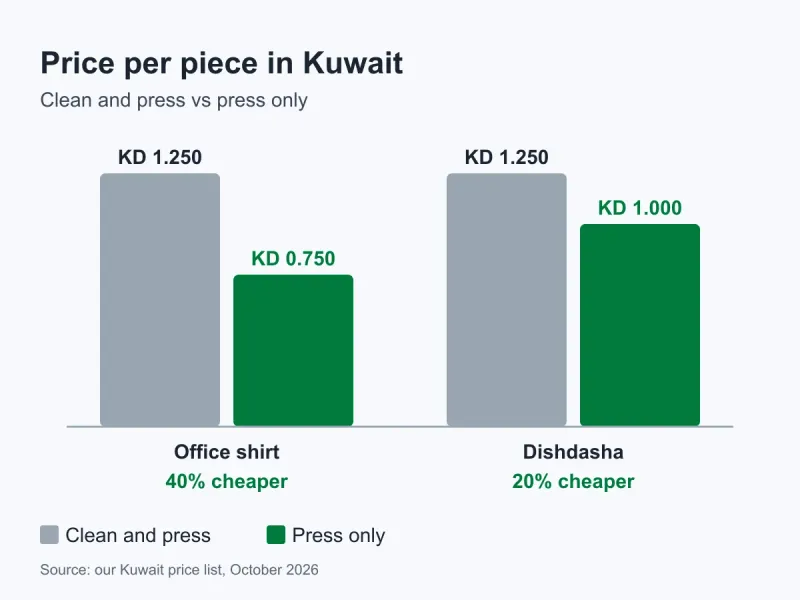
- Shirt, clean and press: KD 1.250. The shirt is cleaned, hand-finished and steam pressed, then returned on a hanger.
- Shirt, press only: KD 0.750. You hand over a clean shirt, it comes back steam pressed on a hanger.
- Dishdasha: KD 1.250 for clean and press, KD 1.000 for press only.
Polo shirts and T-shirts sit at the same prices as a shirt: KD 1.250 cleaned and pressed, KD 0.750 pressed. A ghutra is KD 0.667 cleaned and pressed and KD 0.583 pressed only. The third route, washing and ironing everything yourself, has no price on our list, and we are not going to guess what your water, electricity, detergent and Saturday evening are worth.
One thing that is on the list but does not fit here: the Mixed Wash and Fold bag at KD 5.000 for up to 6 kg. It is good value for everyday clothes, but shirts in it come back folded, not pressed on hangers, so it does not solve the office shirt problem.
What Does a Five-Shirt Work Week Cost over a Year?
Our method is simple and you can redo it with your own numbers. We assumed five shirts a week and 48 working weeks a year, which leaves about four weeks for annual leave and public holidays. That is 240 shirt wears a year. If you work more or fewer weeks, multiply the weekly figure by your own number.
- Clean and press every shirt: 5 x KD 1.250 = KD 6.250 a week, KD 300.000 a year.
- Mixed routine, 2 shirts sent for clean and press, 3 washed at home and sent for press-only: KD 2.500 + KD 2.250 = KD 4.750 a week, KD 228.000 a year.
- Wash all five at home, send for press-only: 5 x KD 0.750 = KD 3.750 a week, KD 180.000 a year.
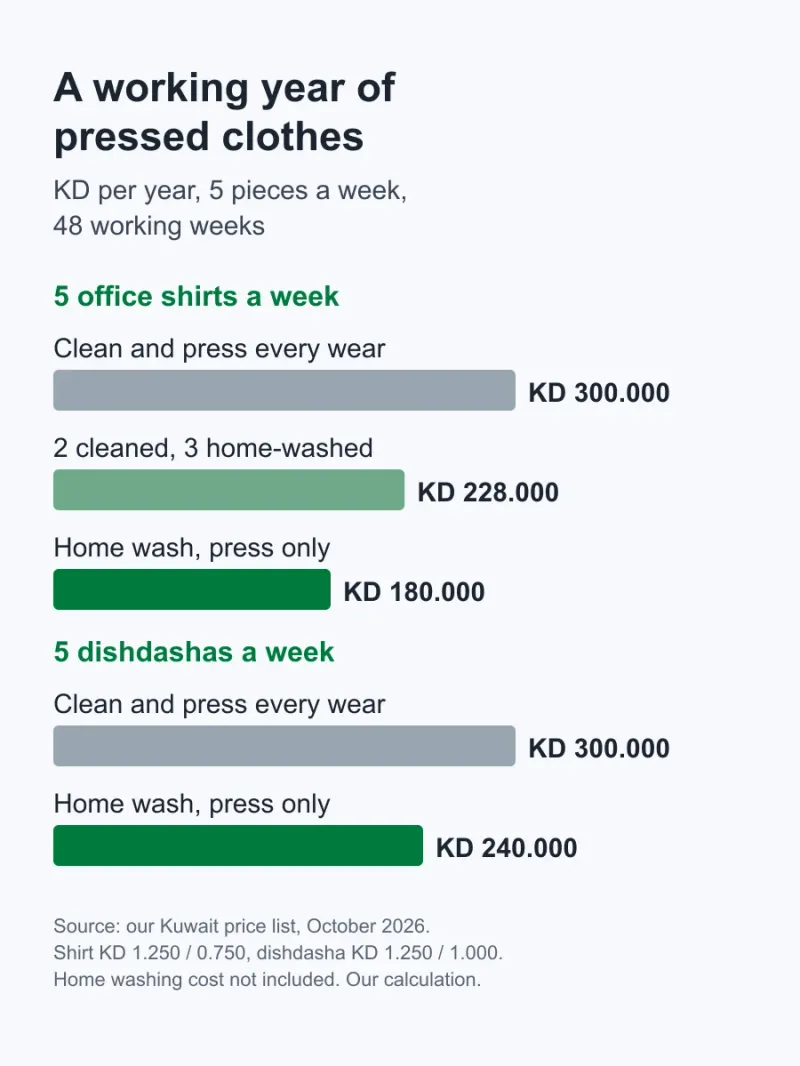
So the full saving from switching every shirt to press-only is KD 120.000 a year. The honest way to read that number is as a ceiling: it is what you save before you count the cost of washing at home. Press-only is worth it if washing a shirt yourself costs you less than KD 0.500 in water, power, detergent and time. For most people with a washing machine already running a weekly load, it does.
Why Is the Dishdasha Week Different?
Run the same five-a-week, 48-week sums for a dishdasha and you get KD 300.000 a year for clean and press (KD 6.250 a week) against KD 240.000 a year for press-only (KD 5.000 a week). The saving is KD 60.000 a year, half of what the shirt routine saves.
The reason is that pressing a dishdasha is most of the work. It is a long garment with a stand collar, cuffs and a front placket, usually in white, and it is pressed with sharp lines and your chosen starch. Pressing alone is KD 1.000 of the KD 1.250 total. Washing it at home saves just KD 0.250 a piece, and that is the step where things go wrong with whites: a grey tint, a yellow collar line, or a sweat mark that the press then sets.
If you add a ghutra to each working day, five ghutras cost KD 3.335 a week cleaned and pressed or KD 2.915 pressed only. Again, the gap is small. For a dishdasha wardrobe, our numbers point one way: send the dishdashas for clean and press, and only use press-only for pieces that are already clean, for example ones that creased in the wardrobe or a suitcase. Our guide on how to clean and whiten your dishdasha covers what to do if you prefer to wash them at home.
When Does a Shirt Need Cleaning, and When Only Pressing?
This matters more than the price. Press-only is a finishing service for clean clothes. It is not a way to stretch a worn shirt into a second day.
- Needs cleaning: any shirt worn for a full working day, even if it looks fine. Sweat and skin oil collect in the collar band and cuffs first, and a shirt that has been in a car, a car park and an air-conditioned office in Kuwait has been through repeated warm and cool cycles.
- Needs cleaning: any shirt with a visible mark, deodorant residue under the arms, or a smell of food or oud.
- Press only: shirts you have washed and dried at home.
- Press only: clean shirts creased from the wardrobe, from packing for a trip, or from being folded in a drawer.
Heat sets what it touches. Pressing a worn collar does not clean it. It bakes the body oil into the fabric, and that is where yellow collar lines come from.
What Are the Trade-Offs for Fabric, Collars and Starch?
Collars and cuffs wear first
On almost every office shirt, the collar fold and cuff edges go before the body of the shirt. They take friction from your neck and wrists all day, and they are folded sharply on every press. Whichever routine you choose, pre-treat the inside of the collar and cuffs before a home wash. A little liquid detergent rubbed in with your fingers is enough. Scrubbing with a brush roughens the fold line and shortens its life.
Starch: soft or medium for daily shirts
With press-only you can choose soft, medium or heavy starch when you book. Starch washes out, so it is not a permanent coating, but a heavy starch on every press makes the collar and cuff folds stiff, and stiff cotton cracks at the fold sooner. For shirts you wear every week, soft or medium is a sensible default. Keep heavy starch for a dishdasha, where a firm finish is the point, or for one shirt you want to look sharp at a meeting or a wedding.
Home washing has its own wear
Washing at home is not automatically gentler. A long hot cycle, a full drum and a tumble dryer on high all add wear, and white shirts dried for hours in direct summer sun can yellow over time. Wash shirts with buttons undone, on a cooler setting, with similar colours, and hang them on hangers to dry so the creases are lighter before they go for pressing. If you would rather hand over the whole household load, our guide to what laundry costs in Kuwait compares every service on the list.
Which Routine Should You Pick?
- You already run a weekly wash at home and hate ironing: wash the shirts with it and send them for press-only. You keep most of the KD 120.000 a year saving.
- You have a few premium or delicate shirts: use the mixed routine. Send those for clean and press and wash the everyday cotton ones at home.
- You have no washing machine, or no time: clean and press for everything. At KD 6.250 for five shirts a week, you pay for the whole job once.
- You wear a dishdasha to work: clean and press is usually the better value, because press-only saves only KD 0.250 a piece.
A common mistake is to switch to press-only and then start pressing shirts that were worn once "only for the morning". That turns a saving into faster collar wear. Another is to send shirts for pressing still damp from the machine, folded in a bag. Let them dry on hangers first so they reach us without set-in fold lines.
How Pickup Works in Your Area
Both services come with free pickup and delivery, and standard orders are back within 24 hours. If you book a pickup on Thursday, the week's shirts can be back on hangers before Sunday. You can see the full press-only service with all garment prices, or browse laundry in Kuwait by area.
In the Capital Governorate, we collect from homes and towers in Kuwait City and Sharq, and there is a dedicated page for press-only in Sharq. In Hawalli Governorate, the same services run in Salmiya and Jabriya, and in the south we cover Fahaheel. To book, message us on WhatsApp and say whether the shirts need clean and press or press only, and which starch you want.
Shirts are one line in a household's laundry bill. For the full monthly picture for one person, a couple and a family of four, see New to Kuwait without a washing machine? A month of laundry, costed.
Frequently Asked Questions
How much does it cost to have office shirts pressed in Kuwait?
On our Kuwait price list (October 2026), press-only for a shirt is KD 0.750 and clean and press is KD 1.250. For five shirts a week over 48 working weeks, that is KD 180.000 a year for press-only and KD 300.000 a year for clean and press.
Is press-only worth it for a dishdasha?
Usually not. A dishdasha costs KD 1.000 to press and KD 1.250 to clean and press, so washing it at home saves only KD 0.250 a piece, or KD 60.000 a year at five a week. For most people that is not worth the risk of greying whites, a missed collar line or uneven starch.
Can I just press a shirt I wore once instead of washing it?
Not after a full working day. Sweat and skin oils sit in the collar and cuffs even when the shirt looks clean, and pressing heat can set them as yellow marks. Press-only is for shirts that are already clean: washed at home, or creased from the wardrobe or a suitcase.
Does starch damage office shirts?
Starch itself washes out, but heavy starch on every press makes collar and cuff fold lines stiff, and those folds are where cotton wears first. Soft or medium starch is a sensible default for daily office shirts. Keep heavy starch for a dishdasha or a shirt you want to look sharp for one occasion.