Abaya Care — Cleaning, Pressing and Storage Done Right
An abaya is worn constantly and is expected to look immaculate every time. It is also, in fabric terms, one of the more demanding things in a wardrobe — usually a fine synthetic crepe that drapes beautifully and reacts badly to heat, often with embellishment that cannot go anywhere near a washing machine.
Know what yours is made of
Most abayas in Bahrain are nida or a similar crepe: a fine polyester weave chosen for how it hangs and how it resists creasing. It is strong but heat-sensitive — a hot iron will melt the surface and leave a permanent shine or, at worst, a hole. Chiffon and georgette layers are lighter and snag easily. Silk and silk-blend abayas are the most delicate and the least forgiving of water.
Feel the weight and check the label before deciding anything. A plain unlined crepe abaya and a beaded silk one are not the same garment and should not be treated the same way.
Why dry cleaning is usually the answer
Water is not the enemy of crepe itself, but the machine is. Agitation stretches the drape unevenly, so the hem stops hanging straight — the classic sign of a home-washed abaya is one side sitting lower than the other. Add any embellishment and a machine becomes actively destructive: crystals lose their adhesive in warm water, sequins scratch the fabric around them, and beading threads break and unravel across a whole panel.
Solvent cleaning avoids all of that. It also handles the oils that abayas actually pick up — perfume, oud oil, makeup and hand cream — better than water does.
Perfume and oud marks
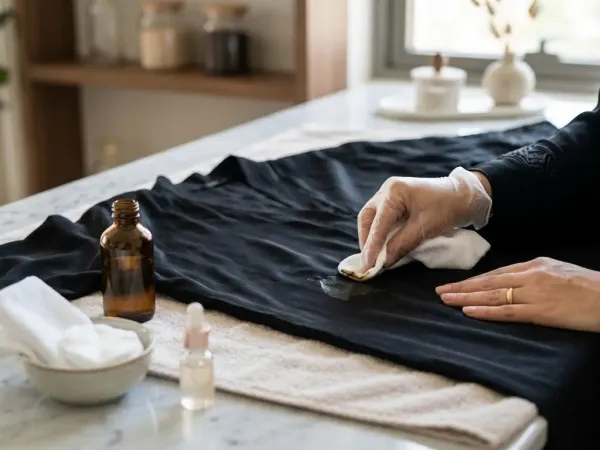
Oud oil is the stain people ask about most, and it behaves differently from food or dirt. It is a concentrated oil, it penetrates fast, it darkens the fabric where it lands, and time makes it dramatically worse. Do not rub it — rubbing spreads it into a halo and grinds it deeper into the weave. Do not apply water, which sets some oil-based fragrances rather than lifting them.
Blot gently with a dry cloth, then get it to a laundry quickly and say exactly what it is and roughly when it happened. Treated within a day or two the odds are good; after a few weeks and a press, much less so. The same applies to bakhoor smoke, which is less a stain than a deposit through the whole garment and needs cleaning rather than airing.
Pressing and steaming
Steam, do not iron, wherever possible. A steamer relaxes creases in crepe without direct contact, which removes the shine risk entirely. If you must iron, use the lowest setting, work on the reverse, and always use a pressing cloth. Never let an iron touch crystals or beading — go around them, not over them.
Storage is where abayas quietly get ruined
Hang on a broad or padded hanger, not wire, which creates shoulder points that never press out. Give each abaya room; crushed against other garments they crease and the embellishment catches. Use a breathable cover rather than plastic — in Bahrain's humidity, sealed plastic traps moisture and that is how mildew and musty smells start.
For an occasion abaya you wear rarely, clean it before storing rather than after taking it out. Invisible body oils and perfume residue oxidise over months into visible yellow marks, and a garment put away dirty comes out worse than it went in.
When to send it out
Anything embellished, anything silk, anything with a stain you cannot identify, and anything you are keeping for a special occasion. Abaya cleaning is priced per item on the price list, with free pickup on orders over BHD 3 — tell us if there is oud or perfume involved and we will treat it accordingly.