Kuwait Dust and Your Washing Line: The Months and Hours to Hang Laundry Outside
Drying speed is rarely the problem in Kuwait. Dust is. A load that dries in two hours on a balcony can come back in duller than it went out, and the usual advice, avoid windy days, does not tell you which months or which hours carry the most dust in the air. So we looked it up.
Quick answer: in the CAMS dust model for 2023 to 2025, the cleanest months for a washing line on Kuwait's coast are December to April, with average dust between 220.8 and 234.8 µg/m³ and about 9 to 11 days a month that see an hour above 500. July is the worst month, averaging 910.9 µg/m³ with 28 such days. Jahra, inland, is dustier than the coast in spring and autumn. In every season, dust is lowest from about 04:00 to 09:00 and highest from 15:00 to 18:00, so hang early and bring the load in by late morning.
Where the numbers come from, and what they cannot tell you
The figures come from the CAMS global atmospheric composition model run by Copernicus, the EU's Earth observation programme, read through the Open-Meteo air-quality service. We pulled the modelled dust concentration at ground level for every hour from 1 January 2023 to 31 December 2025 for six places: Kuwait City, Salmiya, Farwaniya, Mahboula, Fahaheel and Jahra. For each month we averaged the dust level, counted the days on which at least one hour went above 200 µg/m³ and above 500 µg/m³, and divided by three to get a typical year.
Two limits matter. First, the model's grid is coarse, roughly 40 km across. Kuwait City, Salmiya, Farwaniya, Mahboula and Fahaheel all returned exactly the same numbers, so the data cannot tell Salmiya from Mahboula, or Fahaheel from Kuwait City. We call them the coastal cell. Only Jahra came back as a separate cell. Second, this is a model estimate, not a sensor on your street, and three years is a short record. Treat the µg/m³ values as a way to compare months and hours, not as a reading outside your window.
Which months have the least dust for outdoor drying?
Here is the coastal cell, month by month: average dust, then the number of days in a typical month with at least one hour above 500 µg/m³.
- January: 229.5 µg/m³, 11 days. Low dust, but cool and humid, so slow drying.
- February: 226.5 µg/m³, 8.7 days. The fewest heavy-dust days of the year.
- March: 227.7 µg/m³, 9.7 days. Still low on the coast.
- April: 234.8 µg/m³, 9.7 days. The last calm month before the summer rise.
- May: 419.4 µg/m³, 15.3 days. Dust nearly doubles in a month.
- June: 636.7 µg/m³, 22.3 days.
- July: 910.9 µg/m³, 28 days. The dustiest month, about four times December.
- August: 795.5 µg/m³, 24.3 days.
- September: 708.4 µg/m³, 23.3 days. The single worst hour in the record, 3,194 µg/m³, fell in a September.
- October: 436.5 µg/m³, 18 days. Falling, but still about twice the winter level.
- November: 299.7 µg/m³, 11.7 days.
- December: 220.8 µg/m³, 9.7 days. The lowest average of the year.
Across a whole year the coastal cell has 284.3 days with at least one hour above 200 µg/m³ and 191.6 days with an hour above 500. Put simply, some dust in the air is normal here almost every day. What changes through the year is how much, and for how long.
Jahra against the coast: the difference is spring
The Jahra cell sits about 40 km west of the coastal one, and it is dustier over the year: 314.9 days with an hour above 200 µg/m³ and 209 days above 500, against 284.3 and 191.6 on the coast. But the gap is not spread evenly. It is concentrated in spring and late autumn.
- March: 283.6 µg/m³ in Jahra against 227.7 on the coast, about 25% higher.
- April: 324.9 against 234.8, about 38% higher, with 14.3 heavy-dust days against 9.7.
- May: 486.9 against 419.4, with 19.7 heavy-dust days against 15.3.
- October and November: 478.2 and 336.9 in Jahra, against 436.5 and 299.7.
- June to September: the coastal cell is slightly higher, 910.9 against 800.2 in July.
So if you live in Jahra, your outdoor drying season is shorter at the spring end. On the coast, April still looks like a winter month in the model. In Jahra, April already has more heavy-dust days than coastal November. December to February is the window that works in both cells.
What time of day is dust lowest?
This was the most useful result. We averaged every hour of the three years by time of day, in Kuwait time. In both cells and in every season, modelled dust is lowest in the early morning, climbs from about 10:00 and peaks in the late afternoon.
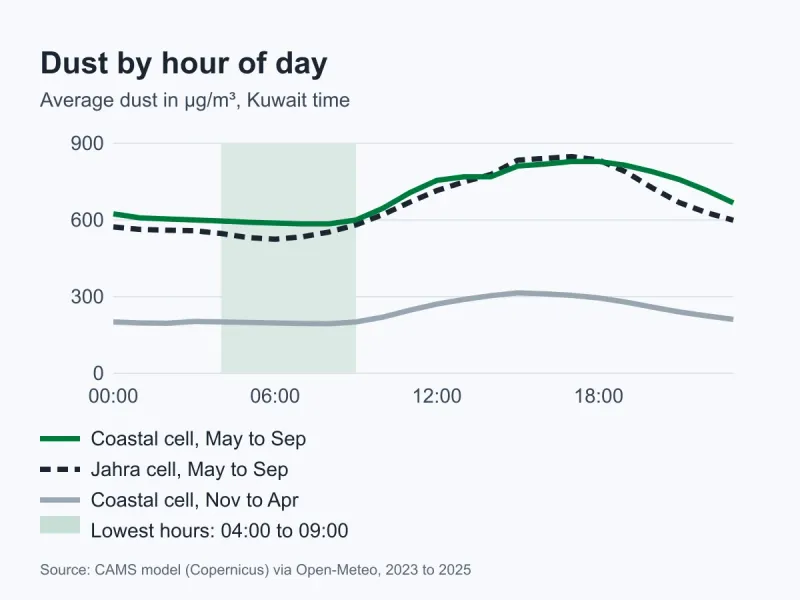
- Coastal cell, May to September: lowest at 07:00 and 08:00 (585 µg/m³), already 707 by 11:00, peaking at 829 at 17:00 and 18:00.
- Jahra cell, May to September: lowest at 06:00 (525), peaking at 848 at 17:00. The early morning is cleaner than on the coast, the afternoon dirtier.
- Coastal cell, November to April: lowest at 08:00 (194), peaking at 315 at 15:00.
In practice: a load hung at 07:00 in summer will be dry long before the air fills up, because humidity on the coast averages 28% to 36% from June to September in the ERA5 weather record. Leave it out until evening and it spends the dustiest hours of the day on the line for no gain.
Why this differs from our drying calendar on October
Our Kuwait drying calendar rates October the best month to dry outdoors, because it has the fewest windy days and no extreme heat. The dust model adds a caution: in October the air still carries about twice the winter dust load, 436.5 µg/m³ on the coast, with 18 days a month that see an hour above 500. Calm days mean less dust is lifted nearby, but dust already in the air has not cleared. Both can be true. October dries well and quickly, and early hanging matters as much then as in summer.
What dust does to washing that is drying
Dry dust on dry fabric mostly shakes off. Dust that lands while fabric is still damp is the problem: fine particles stick to wet fibres and are drawn into the weave as water evaporates. The result is a grey film on whites, a dull cast on black abayas and dark shirts, and towels that feel rough. Fine mineral dust also acts as a mild abrasive in folds and seams, which is why collars and cuffs that dried outside in summer often look tired sooner. We covered the storage side of this in protecting clothes from Kuwait's dust and heat.
When to bring washing in, wash indoors, or send it out
- December to April on the coast, December to February in Jahra: outdoor drying is fine on the dust measure. Humidity is the limit in December and January, so allow longer or finish indoors.
- May to October, everywhere: hang by 07:00 or 08:00 and bring everything in by late morning, before the climb that starts around 10:00. If you cannot be home to take it in, dry indoors.
- March to May in Jahra: treat these like early summer months, not winter ones.
- On a visible dust day: do not hang anything. The worst single hours in the record reached 2,000 to 3,000 µg/m³ in most months from April to November, and a damp load caught in one usually needs washing again.
- Whites, black abayas and office shirts: these show dust film first. Dry them indoors from May to October.
- If a dry load comes in dusty: shake it out outdoors before folding. Do not brush or wipe it damp, which pushes the dust in.
A common mistake is to re-wash a lightly dusted load at once, in the same afternoon, and hang it out again into the dustiest hours. If it has to go back in the machine, dry it indoors or wait for the next morning.
Curtains and sofa covers near open windows collect the same dust between washes, and they are slow and awkward to dry at home. Our carpet and curtain cleaning collects and returns them.
Dust is only half of the drying story. Humidity is the other half, and it changes a lot between the coast and the desert edge: we compared the two in Salmiya vs Jahra: why the same wash dries differently.
Common questions
Which month has the least dust for drying clothes outside in Kuwait?
In the CAMS dust model for 2023 to 2025, December has the lowest average dust on the coast at 220.8 µg/m³, with February close behind at 226.5. In Jahra, January is lowest at 215.1. July is the dustiest month in both places.
What time of day is best to hang washing outside in Kuwait?
Early morning. Averaged over 2023 to 2025, modelled dust on the coast is lowest between about 04:00 and 09:00 Kuwait time and highest between 15:00 and 18:00. From May to September the coastal average climbs from 585 µg/m³ at 07:00 to 829 at 17:00, so hang early and bring the load in by late morning.
Is Jahra dustier than Salmiya or Kuwait City?
Over a year, yes. The model gives the Jahra cell 314.9 days a year with at least one hour above 200 µg/m³, against 284.3 for the coastal cell. The gap is biggest in spring: April averages 324.9 µg/m³ in Jahra and 234.8 on the coast. From June to September the coastal cell is actually slightly higher.
Can the dust data tell Salmiya from Mahboula or Fahaheel?
No. The CAMS model works on a grid about 40 km across, and Kuwait City, Salmiya, Farwaniya, Mahboula and Fahaheel all returned identical figures. Only Jahra, further inland, came back as a separate cell. Any difference between neighbouring coastal areas is below what the model can show.
If the calendar says indoors
From May to October that is most days, and indoor space is short in most flats. That is the gap we fill: we collect, wash and dry indoors, and return most orders within 24 hours, with free pickup and delivery on orders of KD 3.000 or more. On the coast that covers Salmiya, Kuwait City and Farwaniya, and in the south Mahboula and Fahaheel, across the Ahmadi governorate. Inland, see the Jahra governorate. Everything else is on our Kuwait laundry service page, or message us on WhatsApp in Arabic or English.
Dust figures: CAMS global atmospheric composition model (Copernicus), hourly dust at ground level, 1 January 2023 to 31 December 2025, via the Open-Meteo air-quality API. Grid about 40 km: Kuwait City, Salmiya, Farwaniya, Mahboula and Fahaheel share one cell, Jahra is a separate cell. Humidity: ERA5 reanalysis 2016 to 2025 via Open-Meteo. Calculated and reviewed by the Laundrykhalas editorial team, October 2026.