Salmiya vs Jahra: Why the Same Wash Dries Differently
Move from a flat in Salmiya to a house in Jahra and you may notice something odd in your first winter: the same towels, the same machine, the same drying rack, and the laundry is ready sooner. It is not your imagination. The two places sit about 40 km apart, but one is on the Gulf coast and the other behaves, in the weather records, like the desert.
Quick answer: the ERA5 grid cell covering Salmiya averages 85.5 days a year when the daily mean humidity is 60% or more. The cell covering Jahra averages 56.5. Most of the gap falls between November and March, so coastal homes need to plan for indoor drying in those months. In summer the picture flips: both dry fast, but Jahra runs about 4.7C hotter in July, which is harder on colours.
This post is not a month-by-month drying calendar. We already wrote that for Kuwait City in The Kuwait Drying Calendar. This one asks a different question: how much does where you live change the answer?
Where Do These Numbers Come From?
We used the ERA5 reanalysis from the European Centre for Medium-Range Weather Forecasts, read through the Open-Meteo archive: daily values for every day from 1 January 2016 to 31 December 2025, ten years in all. For each place we averaged, per month, the mean relative humidity, the dew point, the daily maximum temperature, the daily maximum wind, and the number of days when the daily mean humidity reached 60% or more. We call those humid days. They are the days when an indoor rack of towels is still damp the next morning.
ERA5 does not measure your street. It divides the region into squares of 0.25 degrees, about 28 km across, and gives each square one value. These are the four squares we used:
- Salmiya: the cell centred on 29.25N, 48.00E. It also covers Jabriya and much of Hawalli governorate.
- Kuwait City: the cell centred on 29.50N, 48.00E. The city sits right on the line between two cells, and the archive returned the one to its north, which is mostly Kuwait Bay.
- Fahaheel: the cell centred on 29.00N, 48.00E. Its centre lies inland, west of the town, so it mostly describes the land behind the coast.
- Jahra: the cell centred on 29.25N, 47.75E, the square directly west of Salmiya's.
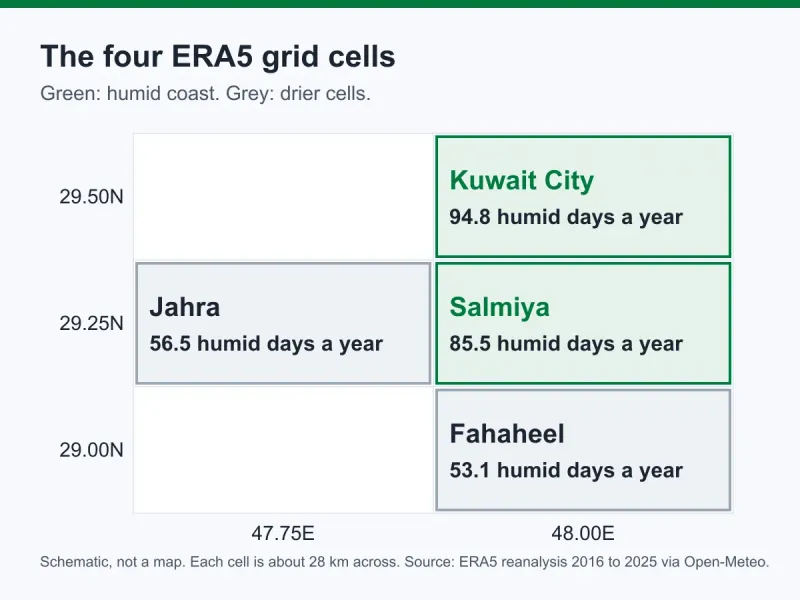
That limit matters. The data cannot tell Salmiya from Jabriya, and it cannot tell the Fahaheel seafront from Ahmadi town. Anyone who claims street-level drying differences from this kind of data is overreaching. What it can show is the broad split between the humid coast and the dry interior. One more note: the drying calendar used a slightly different point for Kuwait City, so its figures differ a little from the ones below.
How Different Is the Coast From Inland?
Side by side, the two neighbouring cells look like different countries for half the year:
- Humid days a year: Salmiya 85.5, Kuwait City 94.8, Jahra 56.5, Fahaheel 53.1.
- November to February: Salmiya 62.7 humid days, Jahra 46.1. Roughly half of all winter days on the coast, well over a third inland.
- December: Salmiya 19.9 humid days at 64.5% mean humidity, Jahra 16.8 at 60.2%.
- January: Salmiya 17.5 humid days, Jahra 12.7.
- August dew point: Salmiya 18.3C, Jahra 11.2C. The coastal air holds much more water, even when it feels dry.
- July daily maximum: Salmiya 42.2C, Jahra 46.9C.
- Wind: almost the same. June's mean daily maximum wind is 27.8 km/h in the Salmiya cell and 29.1 km/h in Jahra's. Wind is not what separates them.
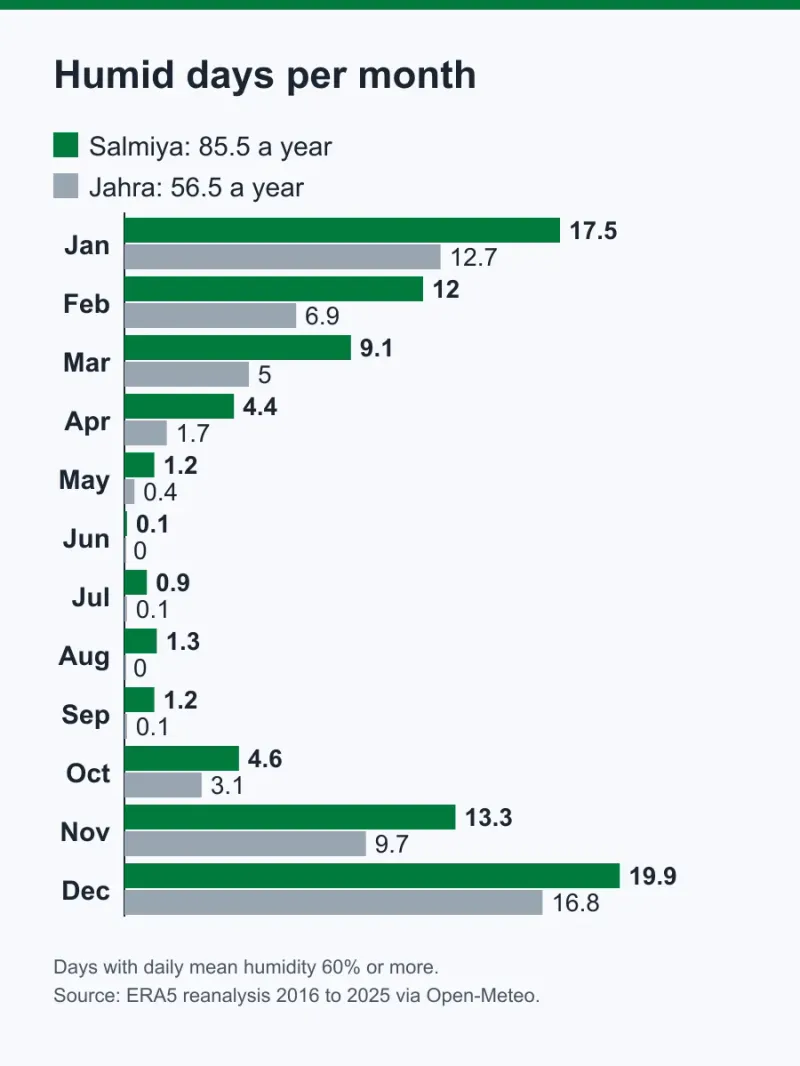
The chart shows where the difference lives. From May to September both cells have one humid day a month or fewer, so drying speed is not the problem anywhere. From November to April the coastal bars stand clearly taller, and that is when your choice of rack, room and timing starts to matter.
Why Does Humidity Change How a Wash Dries?
Water leaves wet fabric only as fast as the surrounding air can take it. When relative humidity is low, the air has plenty of room for more moisture and a towel dries quickly. When it sits above 60% and the day only reaches 20C, as it does in December on the coast, evaporation slows sharply. Thick items such as towels, bedding, jeans and folded seams can stay damp for most of a day indoors.
Dew point tells a related story. It measures how much water is actually in the air, whatever the temperature. In August the Salmiya cell averages a dew point of 18.3C against 11.2C in Jahra. Summer laundry still dries quickly on the coast, because at 42C that moisture is far from saturation. But the air carries more water into closed wardrobes, bathrooms and air-conditioned rooms where it cools, which is part of why coastal flats fight that stale cupboard smell.
What Causes the Musty Smell, and Who Gets It More?
The sour or musty smell in towels and sports clothes comes from microbes that grow while fabric stays damp. The longer the gap between the end of the wash and fully dry fabric, the stronger the smell. Humid days stretch that gap. With about 29 more humid days a year, coastal homes in Salmiya and around Kuwait City have more chances for it to happen, mainly in winter.
- Do not leave a finished load in the drum. This matters more than anything else on a humid day.
- Hang towels fully open, not folded over a rail. Folded layers trap water.
- Leave a hand's width between items on an indoor rack so air can move.
- Run an extra spin cycle for towels and bedding in December and January. Less water in means less time damp.
- Never fold and store anything that feels cool to the touch. Cool usually means still damp inside.
- If the smell is already set, a hot wash usually clears towels. Line drying in the sun will not fix it on its own.
What Should You Do Differently in Salmiya and Kuwait City?
On the coast, treat December and January as indoor months by default, and November, February and March as day-by-day months. Indoor drying works best in the room with the air conditioner or a dehumidifier running, with the door shut, because those machines pull water out of the air as they work. A fan pointed along the rack helps more than people expect.
Timing helps too. Our data are daily averages, so they cannot show the hour-by-hour swing. As a general rule, though, relative humidity is highest around dawn and lowest in mid-afternoon, because the same moisture counts for less as the air warms. On a winter day, start a load early so it can hang through the warmest hours, and bring outdoor washing in before sunset rather than leaving it overnight.
Curtains are the item coastal households most often forget. They hang beside windows where cool glass meets humid air, and they are rarely washed. If yours smell stale, our carpet and curtain cleaning service handles them, so you do not have to dry a full set of drapes indoors in January. The Hawalli governorate and Kuwait City pages list what we collect locally, including Jabriya, which shares Salmiya's grid cell.
What Should You Do Differently in Jahra?
Inland, winter is easier, though not easy. The Jahra cell still averages 16.8 humid days in December and 12.7 in January, so the indoor rack does not disappear. It just comes out less often. The same habits apply on those days, and they hold for Saad Al Abdullah too, which falls in the same grid cell.
Summer is where Jahra asks for more care. The cell averages a 46.9C daily maximum in July and 46.3C in August, against 42.2C and 41.7C in Salmiya's. At that heat, dark fabrics fade quickly in direct sun and cotton dries stiff within the hour. Dry coloured items inside out, in shade, and bring them in as soon as they are dry.
Dust adds to that. A separate dataset, the CAMS atmospheric model from Copernicus for 2023 to 2025, gives the Jahra area 314.9 days a year with at least one hour of ground-level dust at 200 micrograms per cubic metre or more. The Salmiya area gets 284.3. That model's grid is even coarser, about 40 km, so it shows a broad inland and coastal difference, not a neighbourhood one. Our guide on protecting clothes from Kuwait dust and heat covers that side in detail. You can see local collection details on the Jahra governorate page.
What About Fahaheel and the South Coast?
On paper the Fahaheel cell looks like Jahra: 53.1 humid days a year, an August dew point of 11.4C and a 47.1C July maximum. But this is where the grid limit bites. The cell's centre is inland of the town, and most of its area is land towards Ahmadi. Its numbers describe that interior far better than the seafront in Fahaheel or Mangaf.
We cannot tell you from this data how humid a seafront flat in Fahaheel really is. Our practical suggestion: if you live a few streets from the water and your towels behave like Salmiya's, follow the coastal advice above. If you are further inland in the Ahmadi governorate, the Jahra pattern is the closer match. That is a judgement, not a finding, and we would rather say so than pretend the grid can see your building.
Common Mistakes on Both Sides
- Judging the season by temperature. A mild 20C day on the coast can still be a poor drying day if the humidity is above 60%.
- Assuming summer is the same everywhere. Speed is the same. The heat and fade risk are not.
- Drying indoors in a closed room with no air movement. That is the setup most likely to produce musty towels.
- Trusting a neighbour's routine from across the country. What works in Jahra in January can leave a Salmiya load damp overnight.
When Is It Easier to Send It Out?
If December on the coast means a rack in every room, sending the bulky part out is often the simplest fix. Our Mixed Wash and Fold costs KD 5.000 for up to 6 kg on our Kuwait price list, October 2026, with free pickup and delivery and standard laundry back within 24 hours. You can book through the Kuwait laundry service page or on WhatsApp.
Weather figures are ten-year monthly means, 1 January 2016 to 31 December 2025, from the ERA5 reanalysis (ECMWF) via the Open-Meteo archive, licensed CC BY 4.0, for the 0.25 degree grid cells named above. Dust figures are from the CAMS global atmospheric composition model (Copernicus) via Open-Meteo, 2023 to 2025. Reviewed by the Laundrykhalas editorial team, October 2026.
Humidity decides how fast a load dries, but in summer the bigger risk is what settles on it. For the months and hours when dust is heaviest, see Kuwait dust and your washing line.