Ten Kilometres Inland, a Different Drying Year: Umm Salal Against the Coast
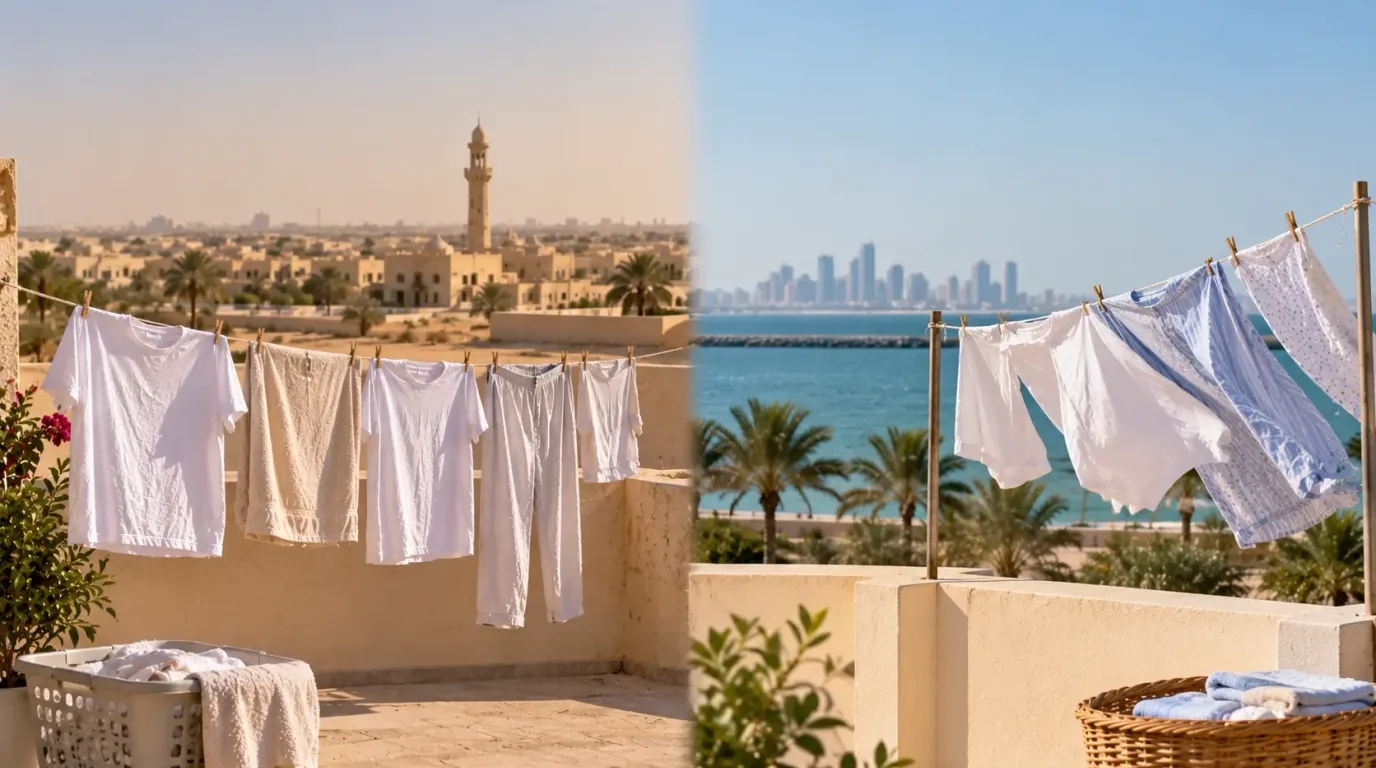
Umm Salal and Lusail sit 10.6 kilometres apart. Plenty of people live in one and work in the other. Nobody would describe them as having different weather, and on any given afternoon they do not.
Averaged across ten years of daily records, they do. We pulled the figures for all six Qatari cities we cover, 2016 to 2025, at each city's own coordinates. Umm Salal is drier than Lusail in eleven months of the twelve, and the two are level in December, and the difference is big enough to change which months a washing line is worth using.
Quick answer: Umm Salal averages 1.5 points drier than the Qatari mean and Lusail 0.9 wetter, a 2.4 point annual gap over 10.6 kilometres. Umm Salal has a genuinely good drying month in March. Lusail does not have one at all.
The Same Year, Two Cities
- January: Umm Salal 66.7%, Lusail 67.2%.
- February: 62.8% against 64.5%.
- March: 53.2% against 56.3%. Umm Salal clears the line, Lusail does not.
- April: 43.1% against 47.3%.
- May: 34.8% against 38.9%.
- June: 34.5% against 37.7%. Both dry, both too hot.
- July: 42.5% against 46.5%.
- August: 50.0% against 53.6%.
- September: 54.8% against 57.6%.
- October: 57.8% against 59.3%.
- November: 62.5% against 62.8%.
- December: 68.6% against 68.5%. The one month they effectively tie.
Why Ten Kilometres Is Enough
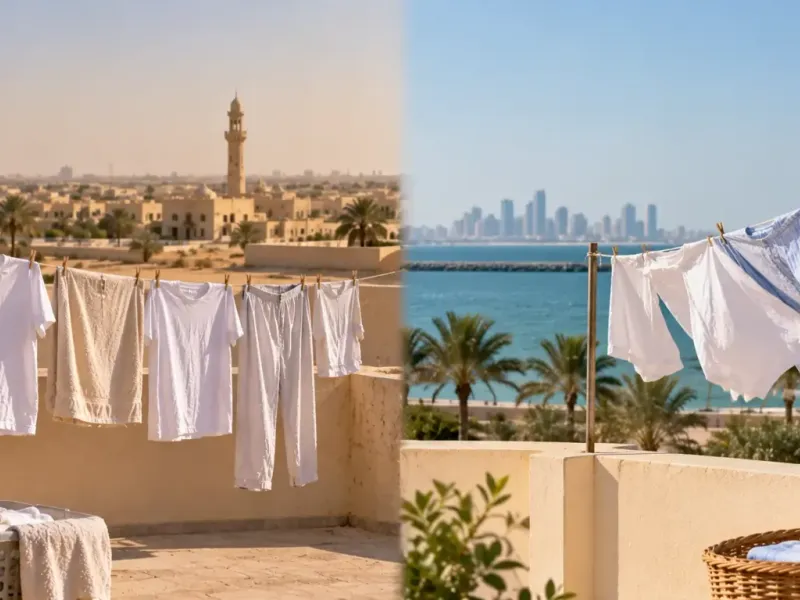
The mechanism is not complicated. Air that has crossed warm shallow coastal water arrives carrying moisture it picked up on the way. Lusail is on that coast, so it gets that air first and at full strength. Umm Salal sits behind it, and by the time the same air has travelled those ten kilometres over land it has given up a measurable share of what it was holding.
That is why the gap is widest in spring and summer, at 4.2 points in April and 4.1 in May, when the sea is warming and the air above it is loading up. And it is why the gap closes to almost nothing in December, when the water is cold, there is little evaporation to carry inland, and both cities sit in the same damp winter air.
Two points of humidity is not something you can feel standing outside. It is something you notice when a load that used to be dry by evening is not.
The Practical Difference: March
Small averages matter when they fall either side of a threshold. In March, Umm Salal averages 53.2% and Lusail 56.3%. Umm Salal is dry enough that an ordinary load dries comfortably in the day, while the daily maximum is still below the point where sun starts bleaching colour. That makes March the one month in Umm Salal that is good on both counts at once.
Lusail never gets that month. It is the only one of the six cities we cover with no month that clears both tests together: by the time the air is dry enough, the heat has already arrived. Ten kilometres inland buys Umm Salal a few weeks that the coast does not get.
What Umm Salal Shares With the Coast
Being inland does not exempt you from the bigger constraint. Seven months of the Umm Salal year average above 33C at the daily maximum, the same as Lusail. In those months the air is dry and clothes dry fast, but the risk has changed: ultraviolet light fades dyed cotton over a season, and airborne dust settles into fabric while it is still wet and sets as it dries.
So the summer rule is identical on both sides of that ten kilometres. Shade, airflow, inside out for anything coloured, and bring it in as soon as it is dry rather than leaving it out to bake.
The Short Version
- Umm Salal is drier than Lusail in 11 months of 12, and ties in December.
- The annual gap is 2.4 points across 10.6 kilometres.
- March is the one clean drying month in Umm Salal. Lusail has none.
- Two months are hopeless in Umm Salal, against three in Lusail and four in Al Khor.
- Seven months average above 33C in both, so summer is shade only either way.
- The gap is widest in April and May and closes to nothing in December.
When the calendar says indoors and you have not got the space, we take the weather out of it. We collect across all 15 areas we cover in Umm Salal and return everything within 24 hours, dried in controlled conditions. Book through our Umm Salal laundry service or message us on WhatsApp in Arabic or English.
Humidity and temperature figures are ten-year monthly means for each city, calculated from daily records between 1 January 2016 and 31 December 2025 from the Open-Meteo ERA5 reanalysis archive, taken at each city's own coordinates and licensed CC BY 4.0. Reviewed by the Laundrykhalas editorial team, September 2026.