Nowhere in Bahrain Is More Than 6.4 km From the Sea. Here Is What That Does to Your Clothes
Bahrain is small enough that no inhabited district is more than 6.4 km from the sea. We measured all 104 of them against the coastline: the median distance is 1.6 km, sixty-six districts sit within 2 km, and 99 of 104 — 95.2% — are within 5 km. That proximity, rather than heat or dust, is the factor that quietly wears out clothing on this island. Salt settles on fabric, holds moisture against it, stiffens cotton and corrodes every piece of metal on a garment.
This is the part of Gulf laundry advice that does not travel. Guidance written for Dubai or Riyadh is about heat and dust. Bahrain's problem is the sea, and it reaches essentially everyone who lives here.
How close to the sea does Bahrain actually live?
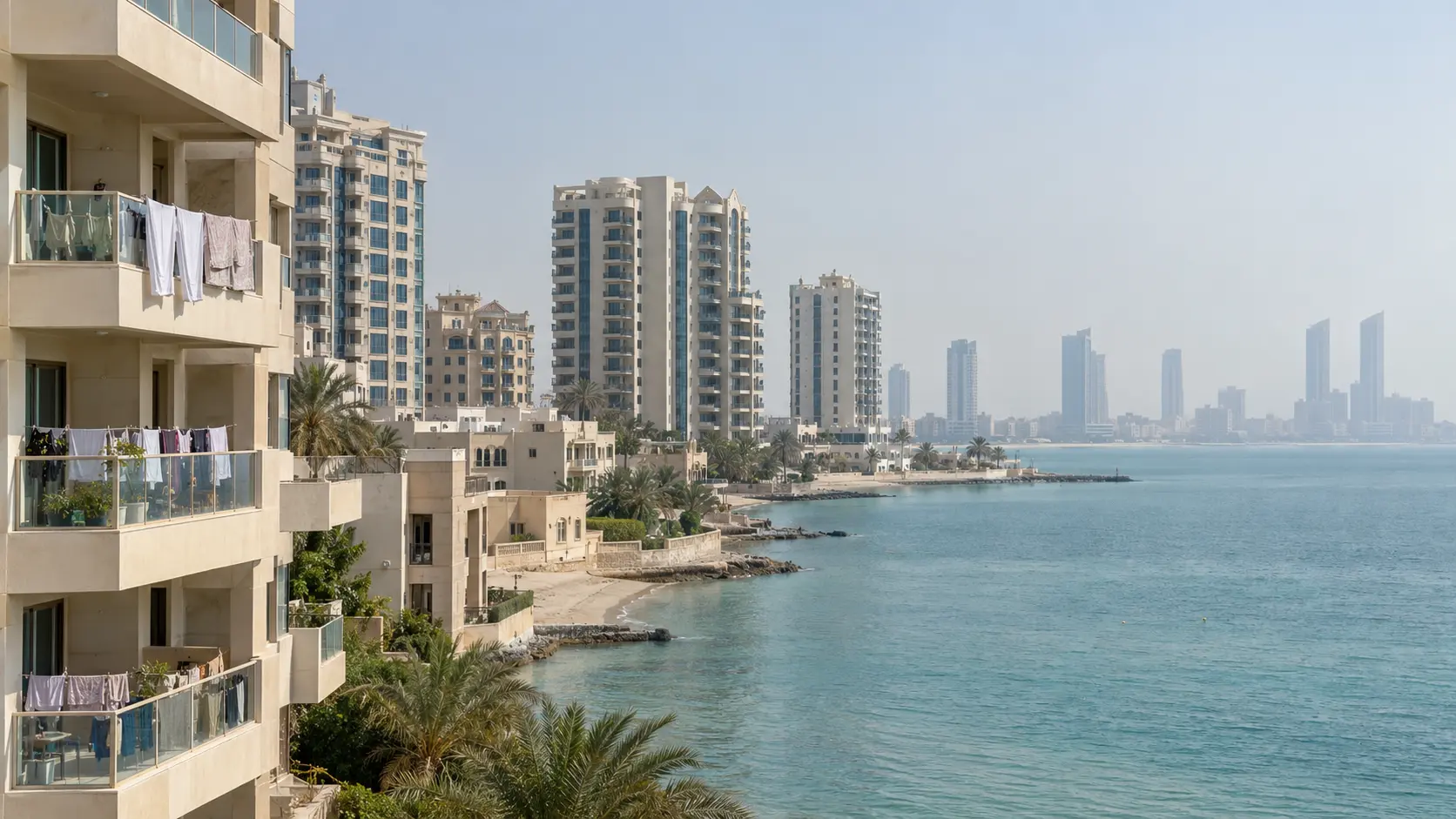
Closer than almost anywhere else that has cities. We took the centre point of each of Bahrain's 104 districts and measured the straight-line distance to the nearest coastline. Nearly two-thirds fall within 2 km of the water, and the single most inland district centre on the island is still only 6.4 km from it.
| Distance from the sea | Districts | Share |
|---|---|---|
| Under 2 km | 66 | 63.5% |
| 2 – 4 km | 30 | 28.8% |
| 4 – 6 km | 7 | 6.7% |
| 6 – 8 km | 1 | 1.0% |
| Over 8 km | 0 | 0% |
- Median distance to the sea: 1.6 km
- Closest district centre: 0.2 km
- Most inland district centre: 6.4 km
- Within 5 km of the coast: 99 of 104 districts (95.2%)
- Within 10 km: all 104
There is no inland Bahrain. There is coastal Bahrain and slightly-less-coastal Bahrain.
Why is salt worse for clothes than dust or heat?
Because salt does not just sit on fabric — it actively pulls water out of the air and holds it. Dust is abrasive but inert, and it brushes or washes off. Salt is hygroscopic, so a garment carrying salt stays slightly damp in humid air, and that dampness is what does the damage over months.
Two consequences follow, and both are familiar to anyone who dries washing outdoors near the water.
Stiffening in cotton and linen
Salt crystals form inside the weave as the fabric dries. The cloth loses its drape and develops a rough, board-like handle, most obvious in towels, bed linen and cotton thobes. It is often mistaken for detergent residue or hard water.
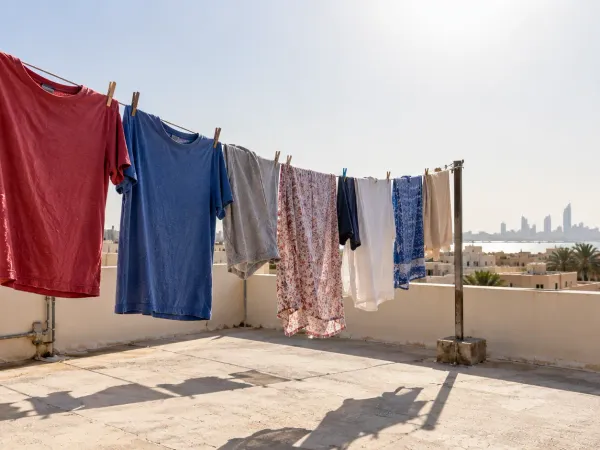
We see this most consistently on cottons hung outdoors in Amwaj Islands, Seef and Muharraq — districts where the line is effectively over the water.
Corrosion on zips, studs and buckles
This is the more expensive failure, because it kills a garment that is otherwise fine. Salt holds moisture against metal fittings long after the fabric has dried, and the zip teeth, slider or press studs corrode from the inside out.
The tell is a garment whose cloth looks new but whose zip has gone stiff, discoloured or seized. In coastal districts we see it on jackets, jeans and bags far sooner than the fabric would suggest.
The clothes do not usually fail first. The metal on them does.
How does Bahrain compare with the rest of the Gulf?
Every Gulf market has a dominant factor that asks the most of a wash, and they are not the same factor. Kuwait and Qatar contend with airborne dust. The UAE's constraint is drying time. Saudi Arabia's is perspiration salts in very dry heat. Bahrain is the only market in the comparison where coastal salt leads.
| Market | Peak months | Mean max | Humidity then | Asks most of a wash |
|---|---|---|---|---|
| Bahrain | Jul–Aug–Sep | 38.5°C | 57% | Coastal salt |
| UAE | Jun–Jul–Aug | 40.6°C | 54.4% | Drying time |
| Qatar | Jun–Jul–Aug | 41.3°C | 47% | Airborne dust |
| Kuwait | Jun–Jul–Aug | 43.9°C | 25% | Airborne dust |
| Saudi Arabia | Jun–Jul–Aug | 42.9°C | 12.2% | Perspiration salts |
| Oman | May–Jun–Jul | 38.3°C | 43.3% | Drying time |
Two things stand out. Bahrain's peak laundry months run a month later than its neighbours — July to September rather than June to August. And it does this at the lowest peak temperature of the Gulf markets bar Oman, while carrying the highest humidity of the group at 57%.
Cooler, wetter, and surrounded by sea. That combination is why advice imported from Dubai or Riyadh misses here.
How do you get salt out of fabric properly?
Rinse before you wash. Salt dissolves easily in fresh water, but it redeposits if the water it is in becomes saturated. A short cold rinse before the main cycle removes most of it, and a proper rinse cycle afterwards clears the rest.
- Rinse in clean fresh water first on anything dried outdoors near the water.
- Do not brush dry salt off. It grinds the crystals into the weave and abrades the fibres.
- Do not overload the drum. Salt needs water volume to dissolve into and carry away.
- Use a full rinse cycle, not an eco-rinse, for coastal-dried loads.
- Dry zips and metal fittings open and fully, so nothing stays damp inside the slider.
- Rinse swimwear and beach towels the same day, not at the end of the week.
What about garments you cannot simply rinse?
Leather, suede, structured bags and lined jackets cannot be flushed with water, which makes coastal salt a genuine problem rather than an inconvenience. Salt left in leather draws moisture continuously and eventually stiffens and cracks it.
These need specialist treatment rather than a wash. Our bag care and shoe care services handle salt removal on materials that cannot go in water, and our guide to leather and bag care in Gulf humidity covers the reasoning.
Does this mean you should stop drying outdoors?
Not necessarily, but it means the choice has a cost that is invisible for the first few months. Outdoor drying in a coastal district trades convenience for gradual stiffening and shortened life on metal fittings.
Whether that trade is worth it depends on the garment and the season — and summer adds dust and UV fade on top of salt. We work through the full case in can you line-dry in Bahrain?, and the winter half of the problem in why clothes dry slower in January than August.
Which Bahrain districts are most exposed?
Anywhere under about 2 km from the water, which is 66 of the 104 districts. In practice the effect is strongest where buildings face open sea with nothing between them and the water — reclaimed waterfront developments and the older island districts.
We collect across every one of them. You can find your area through our Bahrain coverage, including Manama, Muharraq, Riffa and Budaiya.
Which materials suffer most from coastal salt?
Natural fibres and untreated metal. Cotton and linen absorb the salt solution into the fibre itself, while synthetics largely shed it. Metal fittings are the worst affected of all, because corrosion is cumulative and cannot be reversed once it starts.
| Material | What salt does | What to do |
|---|---|---|
| Cotton, linen | Crystals form in the weave; fabric stiffens and loses drape | Fresh-water rinse before washing |
| Wool | Salt plus humidity encourages matting and felting | Do not hang outdoors; clean professionally |
| Silk | Watermarking and dulled surface sheen | Never line-dry near the coast |
| Polyester, nylon | Surface deposit only; little fibre damage | Normal wash is sufficient |
| Leather, suede | Draws moisture continuously; stiffens then cracks | Specialist cleaning — cannot be rinsed |
| Metal zips, studs, buckles | Corrodes from the inside; seizes and stains fabric | Dry fully open; rinse after coastal exposure |
The last row is the one that decides whether a garment survives. A corroded zip frequently stains the fabric around it as well, which turns a repairable fitting into a ruined item.
Does salt change how you should store clothes here?
Yes, and it is the step most people skip. Salt left in fabric keeps drawing moisture from the air for as long as the garment sits in the wardrobe, so anything stored unwashed after coastal exposure stays slightly damp for months.
- Never store anything unwashed after it has dried outdoors near the water.
- Avoid sealed plastic for long-term storage — it traps the moisture salt attracts.
- Leave air space between garments rather than compressing a full rail.
- Check metal fittings before storing seasonal items; corrosion progresses in the wardrobe.
- Store heavy seasonal pieces professionally cleaned, not simply aired.
This matters most for the items that sit unused for months: winter coats, occasion wear, and the thobes and abayas kept for Ramadan and Eid. Our guidance on Ramadan and Eid garment preparation covers the seasonal cycle.
Is the effect worse in some months?
It tracks humidity rather than temperature, which means the worst months are the winter ones. Salt only does its damage while there is moisture for it to hold, so December and January — at 69.5% and 67.9% humidity — are when deposited salt is most active.
That is an unfortunate overlap. Winter is both the season when salt is most damaging and the season when clothes take longest to dry, so they sit exposed for longer.
The short version
- All 104 Bahrain districts sit within 10 km of the sea; 95.2% within 5 km; median 1.6 km.
- The most inland district centre on the island is 6.4 km from the coast.
- Salt is hygroscopic — it holds moisture against fabric and metal, which is why it beats dust for long-term damage.
- Symptoms are stiff cotton and corroded zips, most visible in Amwaj, Seef and Muharraq.
- Bahrain is the only Gulf market where coastal salt, not dust or drying time, is the dominant factor.
- Rinse in fresh water before washing; never brush dry salt off.
Coastline distances are measured from Laundrykhalas district coordinates against the Natural Earth 10m coastline dataset. Climate figures are from the Open-Meteo ERA5 reanalysis archive, 2015–2024, licensed CC BY 4.0. Stiffening and corrosion patterns are from Laundrykhalas collections across Bahrain. Last reviewed September 2026.