Dust Days in Bahrain: Which Months Bring the Most, and When to Bring Washing In
Anyone who has hung a white thobe on a balcony rail in July knows the grey film that can settle on it. The question this post answers is a practical one: which months bring the most dust to Bahrain, at what time of day, and what that means for washing you dry outside. We used three years of public dust data, worked out the numbers ourselves, and kept to what the data can actually show.
Quick answer: June to September is Bahrain's dust season, with July the worst month: 27.7 of its 31 days had at least one hour above 200 µg/m³ of dust in the CAMS model, 2023 to 2025. November is the cleanest month. Bahrain's yearly average is about 35% of Kuwait City's. In summer, dust in the model is lowest in the daytime and about a fifth higher overnight, so dry washing in the shade during the day, bring it in as soon as it is dry, and never leave it out overnight.
Where Do These Numbers Come From?
The figures come from the CAMS global atmospheric composition model run by Copernicus, the European Union's earth observation programme, which we downloaded through the Open-Meteo air quality service. It gives an hourly estimate of dust at ground level in micrograms per cubic metre (µg/m³). We took every hour from 1 January 2023 to 31 December 2025, 1,096 days in all, and counted for each month the average dust level, the days with at least one hour above 200 µg/m³ (we call these dusty days) and the days with at least one hour above 500 µg/m³ (very dusty days).
Two limits matter. First, this is a model estimate, not a reading from a sensor on your street. Second, the model's grid is coarse, about 40 km across. Bahrain's main island is only about 48 km long, so the model cannot tell one town from another.
Does Dust Differ Between Manama, Riffa and Hamad Town?
Not in any way this data can prove. We pulled figures for seven places, and they fall into two near-identical groups. The northern group covers Manama, Juffair, Muharraq and Sitra. The central group covers Isa Town, Riffa and Hamad Town, which came back with exactly the same numbers because they sit in the same part of the grid.
- Manama: yearly average 157.0 µg/m³, 182 dusty days a year, 54.7 very dusty days.
- Isa Town, Riffa and Hamad Town: 156.8 µg/m³, 185 dusty days, 53.3 very dusty days.
- Muharraq and Juffair: 150.0 µg/m³, 166 dusty days, 49 very dusty days.
- Sitra: 150.0 µg/m³, 167.6 dusty days, 50.3 very dusty days.
A gap of 0.2 µg/m³ between Manama and Riffa is noise, not geography. Even the 7 µg/m³ between Manama and Muharraq is too small to choose a home or a drying spot by. For laundry purposes, treat Bahrain as one dust zone, or at most two cells, north and centre, that behave almost the same.
Which Months Bring the Most Dust to Bahrain?
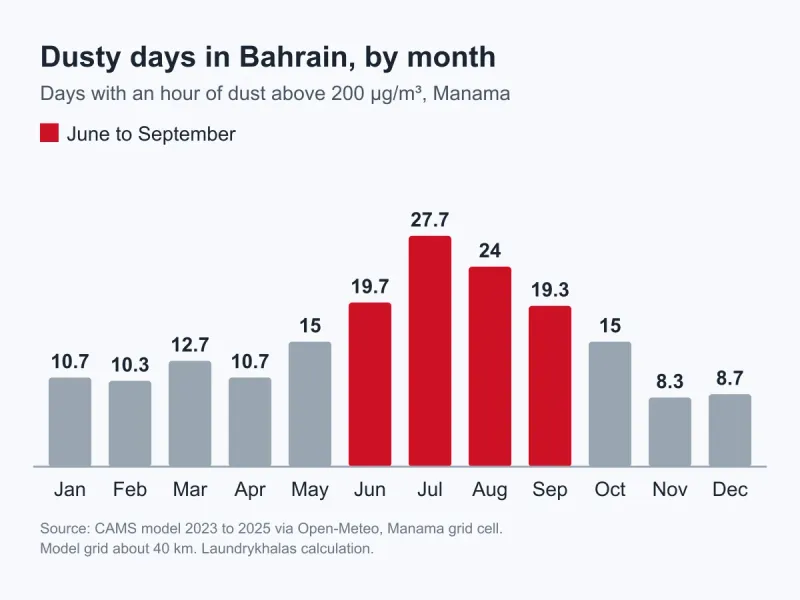
Using Manama as the reference, the year splits into three parts.
- Dust season, June to September. Average dust runs at 203.5 µg/m³ in June, 322.5 in July, 272.7 in August and 217.0 in September. July has 27.7 dusty days and 15.3 very dusty days, so on roughly half of July's days the model shows at least one hour above 500 µg/m³.
- Shoulder months, March to May and October. Averages of 118 to 139 µg/m³ and 10.7 to 15 dusty days a month. May and October both reach 15 dusty days.
- Cleanest months, November to February. November is the lowest at 73.6 µg/m³ with 8.3 dusty days and 1 very dusty day, followed by January at 82.3 µg/m³.
One warning about winter: low averages do not mean no dust. The single worst hour in Manama's three years came in December, at 1,912 µg/m³, and February produced an hour of 1,736 µg/m³. Winter dust events are rare, about 2.7 very dusty days in December and 1.7 in February, but they can be as sharp as anything in summer. If the sky turns hazy on a winter morning, the summer rules below apply that day too.
How Does Bahrain Compare With Kuwait?
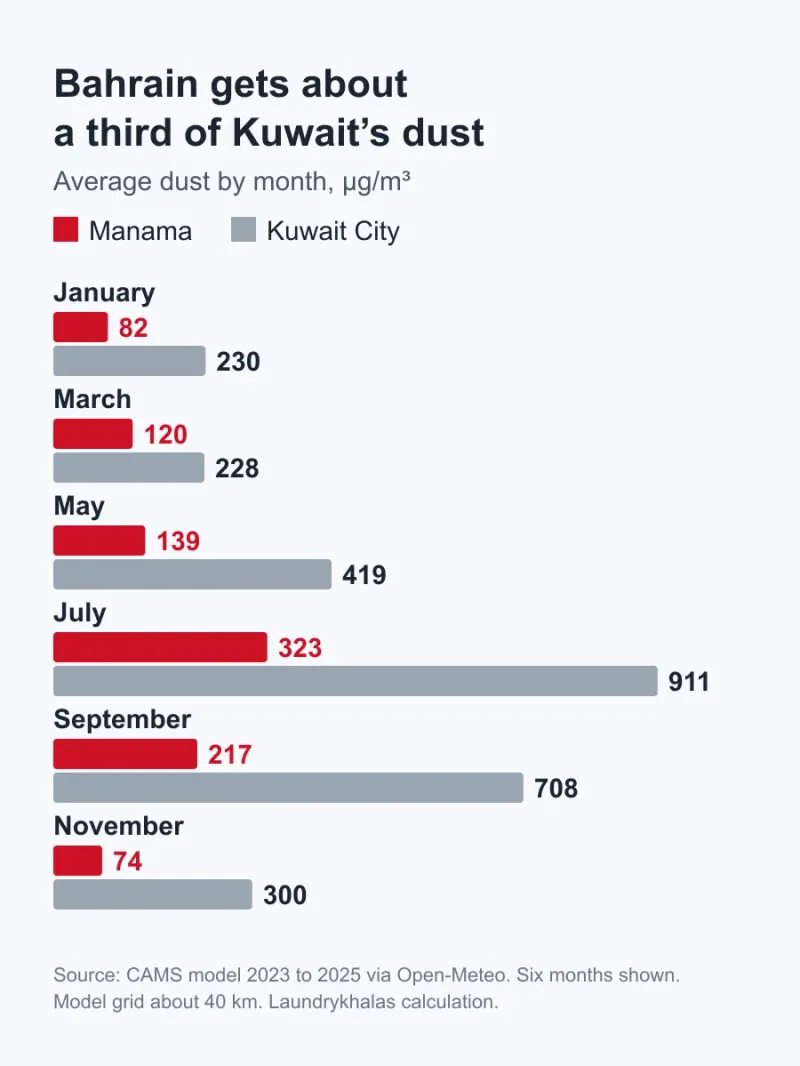
Kuwait sits at the head of the Gulf, next to the deserts of Iraq and northern Saudi Arabia, and the model shows it. Over the same three years and with the same method:
- Yearly average: Manama 157.0 µg/m³, Kuwait City 445.5 µg/m³. Bahrain gets about 35% of Kuwait's dust, roughly a third.
- July: 322.5 against 910.9 µg/m³, again about 35%.
- November: 73.6 against 299.7 µg/m³, about a quarter, the widest gap of the year.
- Very dusty days: 54.7 a year in Manama against 191.6 in Kuwait City, about 29%.
- Worst single hour: 1,912 µg/m³ in Manama against 3,194 µg/m³ in Kuwait City.
From May to November Bahrain's dust runs at a quarter to a third of Kuwait's, from 25% in November to 35% in July. From December to April the gap narrows, because Kuwait's own winter is calmer, and in March and April Manama reaches about half of Kuwait City's level (119.7 against 227.7 µg/m³ in March). Dusty days are also closer than the averages suggest, 182 a year against 284.3, because Bahrain still gets many short dusty spells; what it gets far less of is the heavy dust that hangs around. If you have moved from Kuwait, expect less dust on your balcony, not none.
What Time of Day Is Dust Lowest in Summer?
Because the model is hourly, we also averaged every June to September hour in Manama by time of day, in Bahrain time. The result is clear and useful for anyone who dries washing outside.
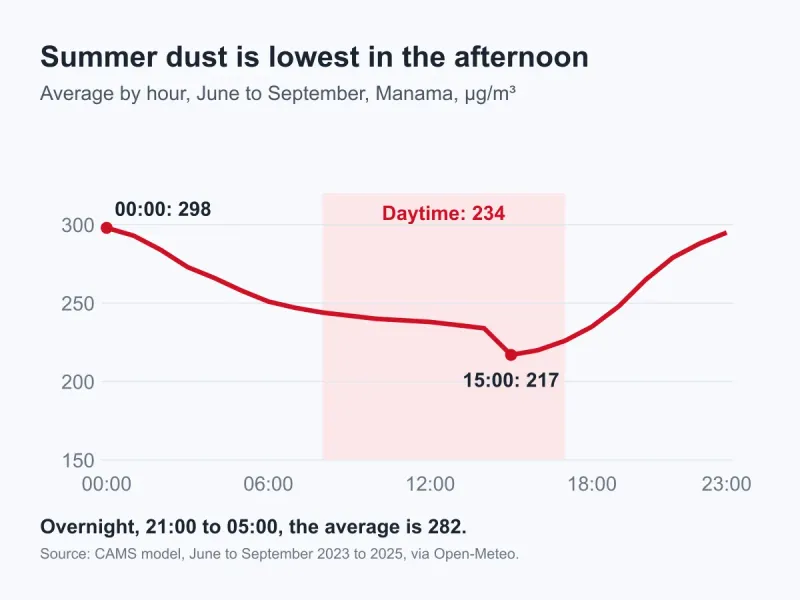
Between 08:00 and 17:00 the summer average is 234 µg/m³, with the low point of 217 at 15:00. Between 21:00 and 05:00 it is 282 µg/m³, about a fifth higher, peaking at 298 around midnight. In the cleaner months the pattern almost disappears: from December to February every hour sits between 84 and 110 µg/m³. Treat this as a pattern in a model, not a forecast for a given day, but it points the same way as common sense: washing left out overnight in summer collects more dust than washing brought in by evening.
What Does This Mean for Washing on the Balcony?
Dust is only one of Bahrain's drying problems. Humidity and sun matter as much, and we have covered them month by month in can you line-dry in Bahrain and why clothes dry slower in winter, so we will not repeat them here. Put together with the dust figures, the practical rules are:
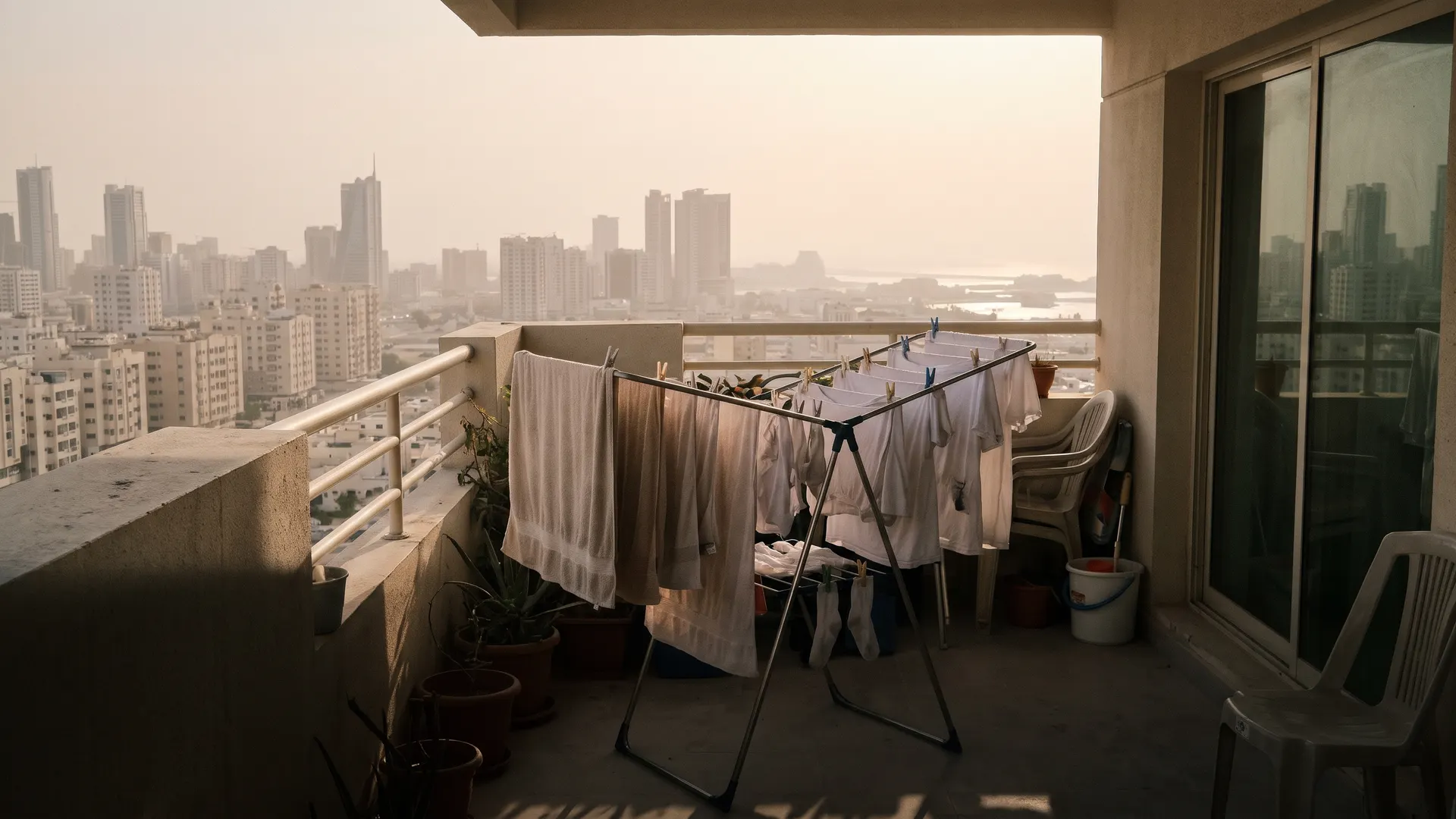
- June to September: dry in the shade or indoors. If you use a balcony, hang washing in the morning and bring it in as soon as it is dry, by late afternoon at the latest. Never leave it out overnight.
- March to May and October: outdoor drying works on most days, but 11 to 15 days a month still bring a dusty hour. Glance at the sky before you hang a load, and bring it in if the horizon turns hazy.
- November to February: the cleanest air of the year, but the slowest drying. Humidity, not dust, is the problem, apart from the occasional sharp winter dust event.
- Wipe the rail first. Dust that settles on balcony rails, drying racks and pegs between loads transfers straight onto wet fabric. A damp cloth over the rail before you hang anything costs a minute.
- Shake before you wash again. If a dry garment has picked up dust, shake or brush it outside before it goes back in the machine, so the dust does not end up in the rest of the load.
Tower balconies in Seef or Juffair and villa courtyards in Riffa share the same air in this data, so the same rules apply to both. Indoor fabrics collect dust too: curtains beside a balcony door that stays open through the summer are a common place for it to build up, and our carpet and curtain cleaning takes them down, cleans them and returns them.
How Do You Keep White Thobes Clean in the Dust Season?
White shows dust first, and a thobe has a lot of white fabric hanging in the open air if it is dried on a balcony. From June to September:
- Dry white thobes indoors, on a hanger, away from an open window. They are the garment where an overnight dusty spell will show most.
- Do not let a dusty thobe sit in the basket for days. Collars, cuffs and the hem are where dust and sweat meet, and the longer they wait the harder they are to bring back to white.
- Keep pressed thobes covered in the wardrobe if your room gets dust through the balcony door.
- A thobe that has gone grey needs a proper wash, not just a press. Our guide to keeping a white thobe white covers the whitening side in detail.
On our Bahrain price list, October 2026, a thobe is BD 1.500 to dry clean and BD 1.200 for press only, returned on a hanger.
Common Mistakes in Bahrain's Dust Season
- Leaving washing out overnight in summer. The model's overnight dust is about a fifth higher than the daytime level, and there is no sun to finish the drying anyway.
- Choosing a drying spot by town. The data shows no meaningful difference between Manama, Riffa, Isa Town or Hamad Town. Shade, cover and timing matter far more than the district.
- Assuming winter is dust-free. December produced the worst single hour in Manama's three years.
- Rewashing everything after a dusty day. Dust on dry clothes can usually be shaken or brushed off. Save the rewash for whites and anything that was still wet when the dust came.
When Is It Easier to Send Washing Out?
If the dust season leaves you with nowhere sensible to dry a full load, our wash and fold service dries everything indoors. A mixed bag of up to 6 kg is BD 6.000, pickup is free from BD 3.000, and it comes back within 24 hours. We collect across Bahrain, and you can book on WhatsApp.
Bahrain gets about a third of Kuwait's dust, but July still brings a dusty hour on 27.7 of its 31 days. In summer, dry in the shade, bring washing in by evening, and keep white thobes indoors.
Moving house in the dusty months? Curtains and rugs gather more in the last weeks than you expect; the cleaning order and costs are in Moving out of a Bahrain flat.