Is Hard Water Greying Your Whites in Kuwait? The Numbers Say No
There is a standard explanation in Kuwait for whites that have gone grey, towels that dry stiff, and detergent that never quite seems to work: the water is hard. It gets repeated in shops, in building WhatsApp groups, and in a good deal of advertising for water softeners.
We set out to write that article. We wanted the hardness figure in mg/L so we could tell people exactly what they were dealing with. What we found instead is that the evidence points the other way, and once you follow it, the advice that falls out is close to the opposite of what people are usually told.
Quick answer: Kuwait's tap water begins as desalinated seawater with almost no dissolved minerals, and the published household measurements are consistent with soft to moderately mineralised water, not the very hard water commonly claimed. If your whites are dulling, the likelier causes are detergent residue and dust.
Where Kuwait's Water Actually Comes From
This is the part that decides the whole question. Kuwait has essentially no fresh surface water, so the municipal supply is produced by desalinating seawater. Desalination does not soften water, it strips it. What comes out of the plant is close to pure, with total alkalinity of less than 1 mg/L as CaCO3, which is so low that it is considered unsuitable for drinking as it stands.
So it is deliberately put back. The desalinated output is blended with brackish groundwater to bring the mineral content up to something the World Health Organization guidelines are comfortable with. Every mineral in Kuwait's tap water is there because it was added back on purpose, in a controlled amount.
Hard water is a problem of geology. It happens when water sits in limestone and picks up calcium and magnesium on the way to you. Kuwait's water does not take that journey. It comes out of the sea, gets stripped to almost nothing, and has a measured amount added back.
That single fact should make anyone pause before accepting the hard water explanation. It does not prove the water is soft at the tap, because the blending step could in principle push hardness up. So we went looking for measurements of what actually arrives at the household.
What the Household Measurements Show
The most useful study we found sampled Kuwaiti homes directly rather than testing at the plant. It collected 322 samples of desalinated household water from 99 locations covering roughly 95% of Kuwait's residential areas, and measured pH, conductivity, total dissolved solids and the major minerals including calcium and magnesium.
Its magnesium result is the clearest signal available: a mean of 10.9 mg/L, across a range of 2.9 to 16.1 mg/L. In hardness terms, magnesium at that level accounts for roughly 45 mg/L as CaCO3. On the standard scale, anything below 60 mg/L is classified soft.
- Under 60 mg/L as CaCO3: soft
- 60 to 120 mg/L: moderately hard
- 120 to 180 mg/L: hard
- Above 180 mg/L: very hard
We want to be straight about the limit of this. Total hardness is calcium and magnesium together, and we could not obtain the study's calcium mean from the sources available to us, so we are not going to publish a total hardness number we have not seen. What we can say is that the magnesium contribution alone sits in soft territory, that the water it was added to had almost no hardness at all, and that nothing in the published record supports the 200 to 400 ppm very hard figure that circulates locally. That figure tends to appear in material selling water treatment equipment.
One more finding matters for you personally: the study reported that results varied by more than tenfold between locations for several parameters. Kuwait does not have one water. Blending ratios and the state of the pipes between the plant and your block both move the numbers. A cheap test strip on your own tap will tell you more than any article, including this one.
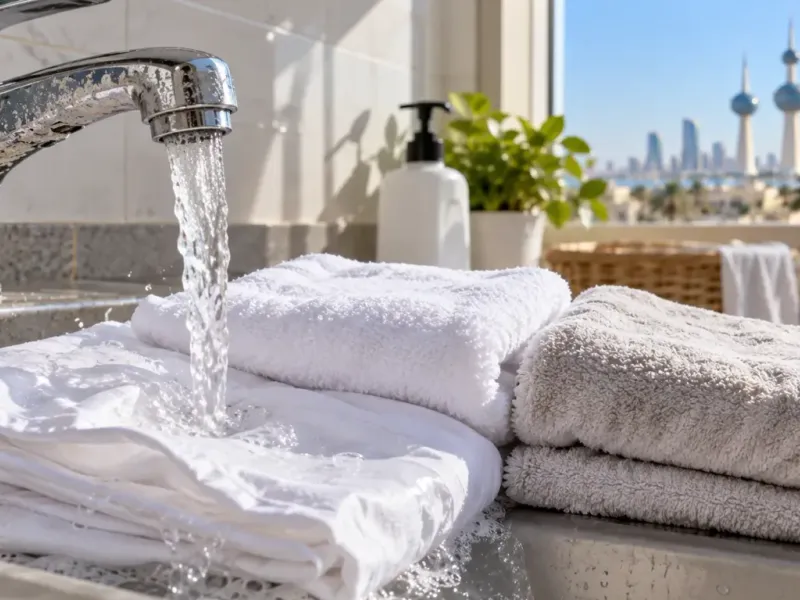
So Why Are the Whites Actually Going Grey?
Because the real cause produces almost exactly the same symptom, which is why the wrong explanation has survived so long. Two things are doing the damage, and they work together.
1. Too much detergent, not too little
Detergent dosing instructions are written for the water most of the manufacturer's customers have, which is the moderately hard to hard supply typical of Europe and North America. A large share of that dose exists to neutralise minerals before any cleaning can start. In soft water there are far fewer minerals to neutralise, so a standard dose leaves a surplus of active surfactant in the drum.
Surplus surfactant foams heavily, and foam is the enemy of rinsing. It cushions the mechanical action the machine relies on, and it does not fully clear in the rinse cycle. What stays behind is a thin, slightly tacky residue sitting in the fibres of everything in the load. On its own it dulls white cotton over time. It also leaves the fabric primed for the second problem.
2. Dust, which Kuwait has in quantity
In our analysis of ten years of Kuwait City weather records, June averages 12.6 days a year with winds above 30 km/h and July averages 11.7. That is the shamal season, and it puts fine desert dust into the air across the whole country. That dust settles into clothing between wears, whether the clothing is on you, on a drying line, or in a wardrobe.
Clean fabric releases most of that dust in the wash. Fabric carrying detergent residue does not, because the residue gives the dust something to hold onto. Each cycle then adds a little more residue and traps a little more dust. The garment gets progressively greyer while never being visibly dirty, which is precisely the complaint people describe when they blame the water.
What to Do Instead
- Cut the detergent by a quarter to a third from the dose on the pack, and judge the result over two or three washes rather than one.
- Check the rinse. Stop the machine during the final rinse and look. Foam at that stage means you are still over-dosing.
- Run a rinse-only cycle on a load of tired whites before changing anything else. If they come out brighter, the problem was residue and you have just proved it.
- Skip the fabric softener on whites and towels. It is designed to deposit a coating, which is the same mechanism that is already dulling them. It is also the main reason towels stop absorbing.
- Wash whites at 40C or above where the care label allows it. Cooler washes leave more residue behind, whatever the water is like.
- Do not overload. A packed drum cannot rinse properly, and rinsing is the entire issue here.
- Test before you buy a softener. If a test shows your block genuinely runs hard, that is real and worth acting on. Buying the equipment first and testing later is how people end up treating a problem they do not have.
The Short Version
- Kuwait's supply is desalinated seawater, leaving the plant at under 1 mg/L alkalinity as CaCO3, then blended back up on purpose.
- Household magnesium averages 10.9 mg/L across 322 samples covering 95% of residential areas, which is roughly 45 mg/L as CaCO3 and sits in the soft band.
- We could not source the calcium mean, so we are not publishing a total hardness figure. The evidence points to soft or moderately mineralised, not very hard.
- Readings vary more than tenfold between locations, so your block is not necessarily your neighbour's.
- The likelier culprits for grey whites are detergent residue and dust, and they reinforce each other.
- The cheapest fix in this entire article is using less detergent.
If a set of whites is already past the point where a rinse cycle helps, restoring them is a different job from washing them, and one worth handing over. We collect across all six governorates and return most orders within 24 hours. Book through our Kuwait laundry service or message us on WhatsApp in Arabic or English.
Water treatment and alkalinity figures from Fanack Water, Water Quality in Kuwait. Household mineral measurements from Mineral Content of Bottled and Desalinated Household Drinking Water in Kuwait, Clean: Soil, Air, Water, 2011, covering 322 samples from 99 locations. Wind figures are ten-year means for Kuwait City from the Open-Meteo ERA5 reanalysis archive, 2016 to 2025, licensed CC BY 4.0. Reviewed by the Laundrykhalas editorial team, September 2026.